10 Marketing Plan Mistakes That Waste Time and Money

Mitch Wilder
Entrepreneur & Systems Thinker

Most marketing plans do not fail because the business owner is lazy or bad at marketing.
They fail because the plan is too vague, too complicated, too disconnected from sales, or plain and simple impossible to execute consistently.
I think this is one of the biggest reasons small businesses stay stuck. Money goes out, campaigns launch, the team stays busy, but revenue does not grow in a predictable way. If you want better results, you do not need more random tactics. You need a clearer plan.
Quick answer
Marketing plan mistakes are strategy and execution errors — unclear targeting, vague goals, too many channels, no ROI tracking, weak sales alignment, copying competitors, ignoring retention, overestimating capacity, and never reviewing the plan — that waste budget and make growth unpredictable. Fix them by simplifying the plan around one audience, one offer, a few focused channels, clear metrics, and a regular review rhythm.
Key Takeaways
- The most common marketing plan mistakes include unclear targeting, vague goals, too many channels, poor ROI tracking, weak sales alignment, and no review process.
- A marketing plan should help your business execute weekly, not just sound strategic in a document.
- If your audience is too broad, your messaging gets weaker and your leads become less qualified.
- Vague goals like “get more leads” create confusion because nobody knows what success actually looks like.
- A simple plan that gets executed will outperform a complex plan that sits untouched.
- Marketing and sales should be built as one system, not treated like separate departments.
- Retention matters just as much as acquisition if you want efficient growth.
- The best marketing plans are reviewed weekly, monthly, and quarterly.
What Are Marketing Plan Mistakes?
Marketing plan mistakes are strategy and execution errors that make your marketing less effective, harder to measure, and more expensive to run.
In other words, these are the planning problems that lead to wasted budget, inconsistent messaging, poor lead quality, and unpredictable growth.
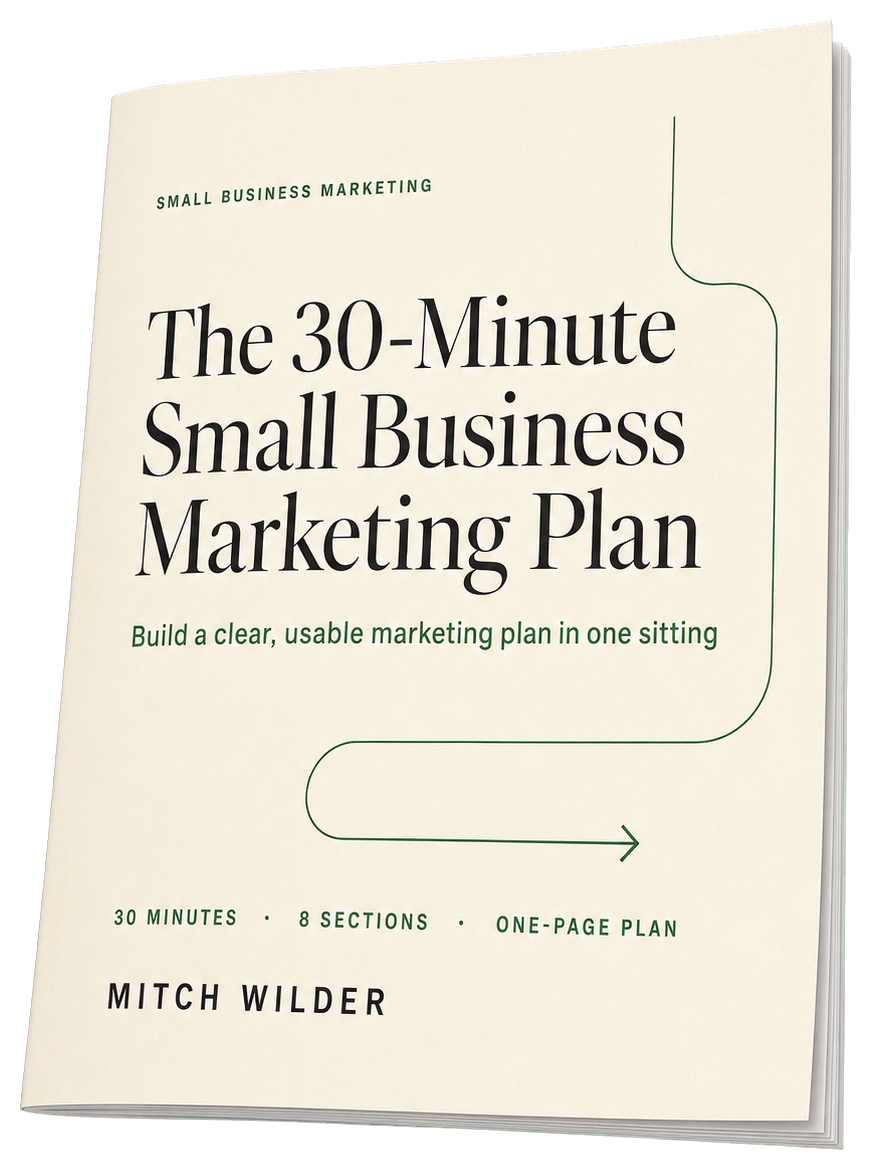
Free checklist
The 30-Minute Small Business Marketing Plan Checklist
Build a usable one-page marketing plan in about 30 minutes. Eight short sections walk you from a clear goal to a 90-day action plan, with fill-in formulas along the way.
Get the checklistWhy Most Marketing Plans Fail Before Execution
Most businesses do not have a marketing plan problem. They have an execution problem.
The way that I look at it, a marketing plan only matters if it can be translated into daily, weekly, and monthly actions. If your plan does not clearly answer who you want to reach, what you are offering, which channels matter, how leads convert, and how performance gets measured, you do not really have a plan. You have a wish list. The fix is a proper small business marketing plan that turns strategy into weekly action.
This is where accidental marketing shows up.
Accidental marketing happens when every new idea becomes a new campaign, but nothing gets enough focus to actually work. One week it is social media. Next week it is SEO. Then it is paid ads. Then a webinar. Then a referral push. Busy? Yes. Strategic? Not even close.
The hidden cost is brutal:
- Money gets wasted on disconnected campaigns
- Time disappears into trial and error
- Teams get confused about priorities
- Sales opportunities get lost in weak follow-up
- Brand trust drops because messaging keeps changing
- Owner confidence takes a hit because results feel random
Mistake #1: Creating a Marketing Plan Without a Clear Target Audience
If your marketing plan does not define who you are trying to reach, every tactic becomes weaker.
I see this all the time. Businesses say things like “we serve everyone,” “we work with small businesses,” or “anyone who needs marketing is a fit.” Those are broad categories, not real target markets.
When your audience is too broad, your message gets generic. Your ads cost more. Your content feels flat. Your sales calls become less qualified. You end up competing on price because relevance is missing.
How do you know if your target audience is too broad?
Your audience is too broad if your messaging could apply to almost anyone, your campaigns bring in unqualified leads, your sales team has to over-explain the offer, or your offer does not feel urgent to the people seeing it.
A better approach is to build a customer avatar around real buying conditions: who the ideal customer is, the problem they are actively trying to solve, the outcome they want, what they have already tried, the objections stopping them, and the exact language they use.
A weak audience definition is “small business owners.” A stronger one is: service-based business owners doing $500,000 to $2 million per year who rely on referrals and want a predictable lead generation system. That level of specificity changes everything.
Mistake #2: Setting Vague Marketing Goals
A marketing plan cannot work if success is not clearly defined.
A lot of goals sound useful but are too vague to guide decisions — get more leads, grow the business, improve social media, increase brand awareness, post more content. The problem is not that these ideas are bad. The problem is they are not measurable enough to help you decide what to do next.
This is not a small detail. CoSchedule’s research found that marketers who set goals are 376% more likely to report success than those who do not.
When I was running my agency, a client came to us frustrated because no matter what they did, they could not scale their Facebook ads. Their goal was “get more customers.” I asked them how many, and we worked it backward together: they wanted to grow by $250,000, each client was worth about $10,000 over 12 months, so the real goal was 25 new clients. They had never done that math. Here is the thing about “more clients” as a goal: one new client technically accomplishes it. Until the goal has a number attached, you cannot know how much you can afford to spend to acquire a client, you cannot judge whether a campaign succeeded, and you cannot build the systems to hit it.
I think every marketing plan should use this simple chain:
- Business goal: Add $500,000 in annual revenue
- Marketing goal: Generate 80 qualified leads per month
- Channel goal: Use SEO and email to create 30 sales calls per month
- Weekly action: Publish 2 articles, send 2 emails, review conversion data every Friday
That is clear. That is actionable. That is how a plan starts becoming real.
Mistake #3: Building an Overcomplicated Marketing Plan
This is one of the most common small business marketing mistakes.
The plan tries to include too many channels, too many campaigns, too many offers, too many audiences, too many metrics, and too many tools. It looks ambitious on paper, but in practice it creates inconsistency. Growth-minded entrepreneurs hear about YouTube, TikTok, LinkedIn, SEO, paid ads, webinars, newsletters, podcasts, referrals, and partnerships, and they want to do all of it.
But complexity does not create momentum. Execution does. A simple marketing plan that gets executed will beat a sophisticated marketing plan that sits in a folder.
Keep it simple:
- One primary audience
- One core offer
- One main message
- One to three primary channels
- One conversion path
- One set of KPIs
- One review rhythm
Mistake #4: Choosing Channels Before Understanding Strategy
Channels are not strategy. They are delivery mechanisms.
If you start with “we need TikTok” or “we should run Facebook ads” because a competitor is on LinkedIn, you are making a tactical decision before a strategic one. That usually fails because the channel may not match customer attention habits, offer price point, sales cycle length, required trust level, or internal resources.
Choose channels after you answer where the ideal customer already spends attention, whether they are problem-aware or solution-aware, whether they need education before buying, how much trust the sale requires, and whether you can stay consistent on that channel for 6 to 12 months. A few simple rules:
- SEO works well when people are already searching
- Referrals work well when trust is everything
- Email works well for nurturing and follow-up
- Paid ads work well when the offer and funnel are already proven
- Social content works well when authority shapes the buying decision
- Partnerships work well when trusted intermediaries already serve the audience
I worked with an ecommerce client who kept pouring money and energy into channels that were not performing, trying to force them to work instead of asking whether she should be on them at all. When we finally sat down with the attribution data, the weak channels were places her ideal customer did not spend time or take buying advice from. The channels that worked were not working because of some magic audience setting. They worked because her customers were naturally there. The proof was her own offline marketing: at an outdoor sports festival full of her exact customers, she would show up with a full trailer of product and leave with an empty one, with a line at her tent. That is what the right channel feels like. Choosing a channel because your competitors are on it is making a decision with no data.
Once strategy is clear, you can match it to specific direct marketing techniques that fit the audience and offer.
Mistake #5: Separating Marketing From Sales
Marketing creates demand. Sales converts demand into revenue.
If your marketing plan only tracks traffic, impressions, followers, and engagement, but ignores lead quality, booked calls, follow-up, close rate, and revenue attribution, you are measuring activity instead of outcomes.
Here is a simple example. Campaign A generates 1,000 leads, but only 5 are qualified. Campaign B generates 40 leads, but 15 book calls and 5 become customers. Campaign B is the better campaign.
Your marketing plan should follow the full customer journey: awareness, interest, lead capture, nurture, sales conversation, purchase, retention, and referral. The takeaway is simple: if marketing and sales are not aligned, your reporting will lie to you.
Mistake #6: Failing to Track Marketing ROI
If you do not track ROI, you cannot tell the difference between growth and waste.
A lot of businesses know how many clicks, likes, opens, and impressions they got. But they cannot answer which campaign produced revenue, which leads became customers, which channel is profitable, which offer converts best, or which campaign should be scaled or stopped.
How do you track marketing ROI?
Set up tracking before campaigns launch. At minimum, track:
- Source and campaign
- Offer and landing page
- Lead status and sales outcome
- Revenue generated
- Cost per acquisition
- Return on ad spend
- Customer lifetime value
The core formula is:
Marketing ROI = (Revenue from campaign − Marketing cost) ÷ Marketing cost
If a campaign costs $5,000 and generates $20,000 in revenue, the profit is $15,000. Divide that by $5,000 and the ROI is 300%. To be fair, not every channel produces immediate ROI — SEO, content, brand, and partnerships often take longer — but even then you still need leading indicators and review checkpoints.
Mistake #7: Copying Competitors Instead of Differentiating
Competitor research is useful. Competitor copying is lazy.
When businesses copy competitor ads, pricing, websites, offers, and funnels, they usually become a weaker version of someone else. Your competitors may have a different budget, reputation, sales process, audience, and stage of growth, so copying what they do without understanding why is risky.
Instead, use competitor research to find market expectations, common promises and objections, messaging gaps, underserved segments, offer weaknesses, and positioning opportunities. Then ask better questions: what do we do better, who are we best positioned to serve, what problem do we solve differently, what proof supports our promise, and why would someone choose us if price were not the main factor? That is strategy.
Mistake #8: Ignoring Customer Retention
A lot of marketing plans are obsessed with getting new customers and completely ignore keeping the ones they already have. That is expensive.
If retention is weak, acquisition gets harder because you are constantly filling a leaky bucket. The math backs this up: Bain & Company found that increasing customer retention by 5% can increase profits by 25% to 95%.
A stronger plan includes retention tactics like:
- Onboarding sequences
- Customer success check-ins
- Email nurture campaigns
- Referral programs and loyalty offers
- Win-back campaigns
- Upsells and cross-sells
- Post-purchase follow-up
A strong marketing plan should answer not only how to get customers, but also how to keep them, grow them, and turn them into referrals.
Mistake #9: Underestimating Budget, Time, and Team Capacity
A plan fails when it assumes resources the business does not actually have.
I have seen plans that expect daily posting, weekly video production, SEO content, paid ads, email newsletters, webinars, reporting dashboards, referral outreach, and new landing pages, all with a tiny team and no real budget. That is not a plan. That is a guilt machine.
Before you finalize the plan, define your monthly budget, team roles, outsourced support, weekly execution hours, tools required, deadlines, approval process, and reporting cadence. Then use this prioritization filter:
- Impact: Will this move revenue?
- Confidence: Do we believe it can work?
- Effort: Can we execute it consistently?
- Speed: How quickly can we learn?
Focus on campaigns that are high impact, high confidence, and realistic for your current capacity.
Mistake #10: Not Reviewing and Updating the Plan
A marketing plan is not a one-time document. It is a living operating system.
Some businesses create a plan and never look at it again. Others change direction every week before anything has enough time to work. Both approaches kill momentum. The goal is not to constantly change the plan. The goal is to improve the plan based on evidence.
Use a simple review rhythm:
Weekly review
Look at execution: did content get published, did campaigns launch, did follow-up happen, and did the team complete the work?
Monthly review
Look at performance: leads, sales calls, conversion rates, campaign costs, revenue, and channel performance.
Quarterly review
Look at strategy: is the audience still right, is the offer converting, are the channels still the best fit, and what should we stop, start, or double down on?
My own rhythm for the past decade: mid-December I assess everything we did that year, refine the plan at the start of the new year, then review quarterly. Quarterly matters because most campaigns need 60 to 90 days to mature past the hyper-responders, and I see far more people change things too fast than too slow. One agency client had a 30 to 60 day selling cycle but tried to adjust their campaign every two weeks. They were making changes before they had enough data to know if they should.
This review habit paid off when I bought a company. I closed the deal around October, let their existing marketing plan run untouched through year end, and just observed. The year-end review flagged an expensive flyer campaign aimed at referral partners. The person running it admitted she felt like she was bugging people, but the previous owners had told her “that’s what we’ve always done.” We cut it for one quarter as a test. We wasted about $1,000 in printed materials, saved a ton of her time, and sales actually ticked up slightly, because the campaign had been annoying the exact referral partners it was supposed to win over. One bad campaign can drag your whole marketing system down, and you only catch it if you actually review the plan.
A Simple Framework to Avoid These Marketing Plan Mistakes
If you want a better plan, use this 7-Part Marketing Plan Checkup:
- Audience: Who are we trying to reach?
- Problem: What urgent problem are they trying to solve?
- Offer: What are we selling, and why is it compelling?
- Message: What promise, proof, and positioning will make them care?
- Channels: Where will we reach them consistently?
- Conversion path: What happens after someone shows interest?
- Metrics: How will we know if it is working?
Before you launch anything, ask: is the audience specific, is the goal measurable, is the offer clear, is the message differentiated, are the channels realistic, is there a follow-up system, are sales and marketing aligned, are KPIs defined, is there a review schedule, and can the team actually execute this?
Weak Marketing Plan vs. Strong Marketing Plan
A weak plan sounds active but skips the essentials. A strong plan defines who you serve, what outcome matters, which channels matter, what offer is promoted, what actions happen, and what metrics get reviewed.
| Element | Weak plan | Strong plan |
|---|---|---|
| Audience | “Everyone” or undefined | Service businesses doing $500K–$2M per year |
| Goal | “Grow” or “more leads” | 60 qualified leads per month |
| Channels | A bit of everything | SEO, LinkedIn, and email |
| Offer | Unclear | Free marketing audit leading to a strategy call |
| Metrics | Likes, impressions, followers | Leads, calls booked, close rate, revenue |
Frequently Asked Questions About Marketing Plan Mistakes
What is the biggest mistake in a marketing plan?
The biggest mistake is building the plan without a clearly defined target audience. If you do not know exactly who you are trying to reach, your messaging, channels, and offers will usually become too broad to perform well.
Why do marketing plans fail?
Marketing plans usually fail because they are vague, overcomplicated, disconnected from sales, poorly tracked, or not executed consistently. A lot of businesses also chase tactics before they clarify strategy.
How often should a marketing plan be reviewed?
Review it weekly for execution, monthly for performance, and quarterly for strategy. That rhythm gives you enough consistency to learn without constantly resetting the plan.
How do you fix a bad marketing plan?
Simplify it. Clarify the audience, make the goals measurable, reduce the number of channels, improve the offer, connect marketing to sales, track ROI, and create a review process.
What should every marketing plan include?
Every marketing plan should include a target audience, clear goals, offer strategy, positioning, channel strategy, budget, timeline, responsibilities, conversion path, KPIs, and a review schedule.
What is accidental marketing?
Accidental marketing is when every new idea becomes a new campaign but nothing gets enough focus to work — one week social media, the next SEO, then ads — which keeps the team busy without producing predictable growth.
Final Thoughts
The best marketing plan is the one your business can actually execute.
It does not need to be complicated. It needs to be clear. It needs to define the audience, the offer, the message, the channels, the conversion path, and the metrics. Most marketing plan mistakes come from trying to do too much, measuring too little, or chasing tactics before strategy is clear.
When you fix those mistakes, marketing gets less chaotic and a lot more predictable. You stop guessing, you stop wasting money, you stop chasing every new idea, and you start building a real growth system.
Related Reading
- How to create a small business marketing plan — the step-by-step system that prevents every mistake on this list.
- The essential elements of a small business marketing plan — the components every plan should include before you launch.
- 12 effective direct marketing techniques — how to turn a focused plan into campaigns that drive a measurable response.
- 12 marketing strategies for startups that actually work — how to avoid these same mistakes when you are early-stage and resources are tight.
- Strategies for scaling a small business — once the plan is fixed, how to grow revenue without letting costs and complexity grow at the same rate.