Effective Competitor Analysis Techniques for Small Businesses

Mitch Wilder
Entrepreneur & Systems Thinker

If you’re trying to grow a small business and it feels like competitors are everywhere, I think the problem usually isn’t a lack of effort. It’s a lack of clarity.
Most business owners do competitor research in a way that creates anxiety, not advantage. They scroll websites, check prices, look at Instagram, and end up copying random tactics. That’s accidental marketing, plain and simple.
The way that I look at it, competitor analysis techniques should help you make better decisions. They should show you where competitors are strong, where customers are frustrated, and where your business can win without wasting time or money.
Quick answer
The most effective competitor analysis techniques for small businesses include SEO analysis, website and funnel teardowns, messaging and positioning analysis, offer and pricing comparison, customer review mining, content and ad analysis, and sales-experience benchmarking. Use the simple G.A.P. framework — Gather data, Analyze strengths and gaps, Prioritize actions — to turn research into a focused 90-day plan instead of another document in a folder.
This is not busywork. Getting focused on the right customers pays off: acquiring a new customer is five to 25 times more expensive than keeping an existing one (Harvard Business Review), so understanding why customers choose competitors — and why they leave them — protects both sides of the ledger.
Key Takeaways
- Competitor analysis techniques help you study competing businesses and turn market observations into better marketing, sales, and pricing decisions.
- The goal is not to copy competitors. The goal is to identify gaps, improve your offer, and sharpen your message.
- Small businesses should analyze direct competitors, indirect competitors, SERP competitors, and aspirational competitors.
- The simplest framework is G.A.P.: Gather data, Analyze strengths and gaps, Prioritize actions.
- The highest-value areas to review are SEO, website conversion paths, messaging, pricing, reviews, content, ads, and customer experience.
- Customer reviews are one of the best sources of insight because they reveal what buyers actually value, fear, and complain about.
- A competitor analysis matrix makes the research usable instead of scattered across notes and screenshots.
- The best insights are the ones you can turn into a 90-day action plan tied to leads, conversions, retention, or revenue.
What Is Competitor Analysis?
Competitor analysis is the process of researching businesses that compete for the same customers, search visibility, budget, or attention. The goal is to understand how they position themselves, what they sell, how they market, and where your business can differentiate.
In other words, this is not a school exercise. It’s a decision-making tool.
| Competitor Type | Meaning | Example |
|---|---|---|
| Direct competitor | Sells a similar offer to the same audience | Another local bookkeeping firm |
| Indirect competitor | Solves the same problem differently | Accounting software instead of a service |
| SERP competitor | Competes for the same Google rankings | A directory or blog ranking above you |
| Aspirational competitor | A business you may grow into competing with | A larger regional agency |
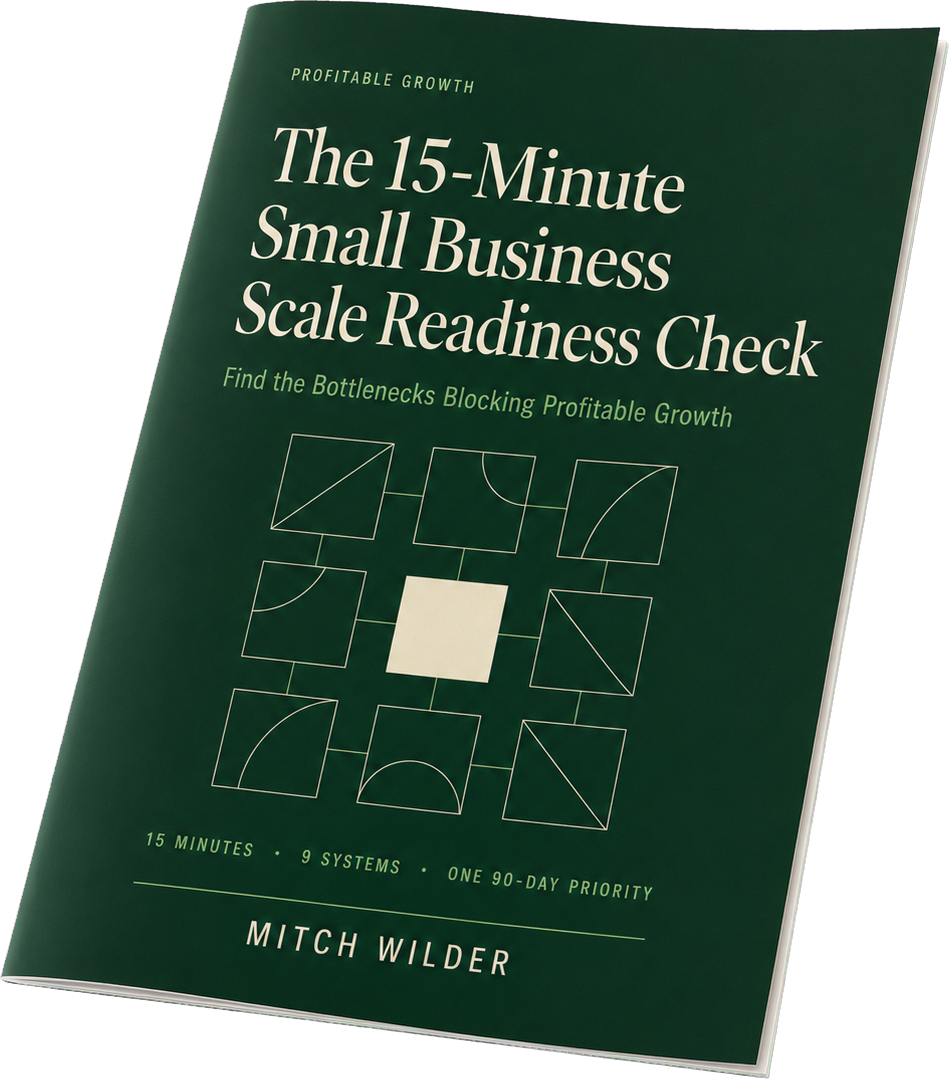
Free checklist
The 15-Minute Small Business Scale Readiness Check
A 45-item checklist across 9 sections that tells you whether your business is ready to scale, where your bottlenecks are, and what to fix in the next 90 days.
Get the checklistWhy Competitor Analysis Matters for Small Businesses
Competitor analysis matters because small businesses don’t have unlimited time, budget, or margin for error.
If you’ve been doing accidental marketing for years, competitor analysis gives you a clearer way to decide what deserves your time, budget, and attention. That’s the real value.
It helps you:
- Find market gaps
- Improve your value proposition
- Understand why customers choose others
- Improve pricing strategy
- Build better landing pages
- Identify SEO opportunities
- Reduce wasted ad spend
- Improve customer acquisition and retention
My point is this: competitor analysis is not just a marketing function. It influences sales, operations, service design, and business growth strategy. It also pairs naturally with the wider market view — if you want to zoom out from individual rivals to the whole landscape, see how to analyze market trends for strategic growth.
The G.A.P. Competitor Analysis Framework
The best competitor analysis framework for most small businesses is simple:
- G — Gather competitor data
- A — Analyze strengths, weaknesses, and market gaps
- P — Prioritize the highest-impact actions
Gather
Collect public information from:
- Competitor websites
- Google search results
- Reviews
- Social profiles
- Pricing pages
- Ads
- Emails and lead magnets
- Google Business Profiles
- Public sales materials
Analyze
Look for patterns:
- What are they doing well?
- Where are customers frustrated?
- What are they unclear about?
- What objections do they handle poorly?
- What keywords or offers seem to drive traffic?
Prioritize
Turn research into action:
- Rewrite a homepage
- Launch new service pages
- Test a better CTA
- Improve follow-up speed
- Create SEO content
- Adjust packaging or guarantees
Right? Research only matters if it changes behavior.
Step 1: Define the Business Decision You’re Trying to Improve
Before you do any competitor research, define the business question.
Weak objective:
“We want to understand our competitors.”
Strong objective:
“We want to understand why three competitors outrank us for high-intent keywords and what we should build in the next 90 days to increase qualified leads.”
This matters because focused research produces useful answers. Unfocused research produces noise.
Good starting questions:
- Are we trying to increase qualified leads?
- Are we losing deals to a specific competitor?
- Are competitors outranking us on Google?
- Are we trying to improve conversion rate?
- Are customers rejecting our pricing?
- Are we entering a new market?
Tie this to measurable outcomes like:
- Organic traffic
- Keyword rankings
- Conversion rate
- Cost per lead
- Close rate
- Customer acquisition cost
- Retention
- Revenue
Step 2: Choose the Right Competitors to Analyze
One of the things that I noticed is that small businesses either analyze one obvious competitor or twenty random ones. Both are mistakes.
A better mix is:
- 3 direct competitors
- 2 indirect competitors
- 2 SERP competitors
- 1 aspirational competitor
Use these sources to find them:
| Source | What It Reveals | Best For |
|---|---|---|
| Google Search | SEO competitors and content gaps | Organic growth |
| Reviews | Pain points and complaints | Messaging and offer improvement |
| Competitor websites | Offers, pricing, CTAs, positioning | Conversion improvement |
| Social media | Themes and engagement | Content strategy |
| Paid ads | Active offers and angles | Direct response marketing |
| CRM and lost deals | Real objections | Sales improvement |
Also ask customers directly:
- Who else did you consider?
- What made you choose us?
- What almost stopped you from buying?
- Who did you compare us against?
That’s often more valuable than another hour on social media.
Technique 1: SEO Competitor Analysis
SEO competitor analysis shows you how competitors attract organic traffic and which keywords drive attention.
Look at:
- Keywords they rank for
- Keywords you don’t rank for
- Top organic pages
- Local search visibility
- Backlinks
- Featured snippets and other SERP features
Focus on high-intent searches, not vanity traffic. I’d rather rank for a keyword that books calls than one that gets random visitors.
Useful tools include:
- Google Search
- Google Search Console
- Google Trends
- Google Keyword Planner
- Ubersuggest
- Ahrefs
- Semrush
- SpyFu
Your output should be practical:
- 10 keyword gaps
- 5 content ideas
- 3 landing pages to improve
- 3 backlink opportunities
- 1 priority SEO campaign for the next quarter
Technique 2: Website and Conversion Funnel Teardown
A competitor’s website is not just a design reference. It’s usually a lead generation system.
Review these areas:
- Homepage headline clarity
- Core promise
- Offer strength
- Social proof
- CTA placement
- Service page quality
- Pricing visibility
- FAQs
- Lead magnets
- Mobile experience
- Form friction
Score competitors from 1 to 5 on:
- Clarity
- Trust
- Differentiation
- Offer strength
- Ease of action
- Mobile usability
- Proof
Here’s the important nuance: if a competitor has a mediocre website but strong growth, they may be winning somewhere else in the system. Maybe referrals. Maybe SEO. Maybe faster follow-up. Don’t assume the homepage tells the whole story.
Technique 3: Messaging and Positioning Analysis
Messaging analysis helps you understand how competitors describe their value and whether they all sound the same.
Document for each competitor:
- Who they serve
- What problem they solve
- What outcome they promise
- What language they repeat
- What proof they use
- What objections they address
- What makes them different
Watch for generic claims like:
- “We care about our customers”
- “Results-driven”
- “Affordable pricing”
- “Full-service solutions”
If everyone in your market says the same vague thing, that’s good news. Specificity wins.
| Competitor | Main Promise | Proof Used | Messaging Gap |
|---|---|---|---|
| Competitor A | Save time | Testimonials | No ROI proof |
| Competitor B | Scale faster | Case studies | Weak pricing clarity |
| Your Business | Predictable qualified leads | Case studies + process | Opportunity to own niche |
Technique 4: Offer and Pricing Analysis
Competitor pricing analysis is useful, but only if you compare the full offer.
Review:
- Price points
- Packages
- Guarantees
- Bonuses
- Payment terms
- Delivery speed
- Onboarding
- Support
- Contract terms
- Free trials or consultations
A competitor charging more is not automatically overpriced. They may simply have better packaging, better proof, or a lower-risk buying experience.
| Competitor | Price | Guarantee | Weakness | Opportunity |
|---|---|---|---|---|
| Competitor A | $997/mo | None | Weak onboarding | Add a guided onboarding process |
| Competitor B | $2,500/mo | 30-day guarantee | Vague deliverables | Offer clearer package structure |
Choose differentiation before discounting. Racing to the bottom is not a strategy.
Technique 5: Customer Review and Voice-of-Customer Mining
This is one of the best competitor analysis techniques because customers will tell you exactly where competitors are strong and where they fail.
Search:
- Google Reviews
- Yelp
- Trustpilot
- G2
- Capterra
- YouTube comments
- Facebook reviews
- Industry forums
Build a simple language bank with:
- Repeated complaints
- Common praise
- Desired outcomes
- Buying objections
- Emotional drivers
- Exact customer phrases
Example:
“Great service, but slow to respond.”
That can become a positioning angle like:
“Same-day response, every business day.”
That angle is more than a slogan — speed genuinely wins deals. Harvard Business Review found that firms that respond to an inbound lead within an hour are roughly seven times more likely to qualify it than those that wait even 60 minutes longer. If reviews say a competitor is slow, faster follow-up is a real edge.
Another example:
“They were hard to understand.”
That can become:
“Plain-English strategy with no jargon.”
The takeaway is simple: reviews tell you what to say, what to fix, and what to promise carefully.
Technique 6: Content and Social Media Analysis
Look at competitor content to understand what the market responds to, not to copy their calendar.
Review:
- Blog posts
- Guides
- Case studies
- Videos
- Newsletters
- LinkedIn posts
- YouTube videos
- Webinars
Ask:
- What do they teach?
- What do they sell?
- What do they repeat?
- What gets engagement?
- What do they avoid?
Content gaps are often more valuable than popular topics. If competitors avoid comparisons, pricing questions, or beginner education, that may be your opening.
Technique 7: Paid Ads and Direct Response Analysis
Competitor ads can reveal active offers, pain points, and sales angles.
Use:
- Meta Ad Library
- Google Ads Transparency Center
- LinkedIn ad visibility
- TikTok Creative Center
- Landing page reviews
Study:
- Hook
- Headline
- Offer
- CTA
- Landing page
- Lead magnet
- Social proof
- Urgency
- Risk reversal
But don’t assume every visible ad is profitable. Visibility is not proof. Use it as directional input.
Technique 8: Sales Process and Customer Experience Analysis
Sometimes competitors win because they make buying easier.
Analyze:
- Lead response time
- Booking process
- Proposal clarity
- Follow-up emails
- Onboarding
- FAQs
- Support accessibility
- Retention process
Use ethical methods only:
- Subscribe to public newsletters
- Download public resources
- Attend public webinars
- Ask customers about their buying experience
Avoid fake identities, deceptive requests, or anything that crosses the line. Plain and simple, good strategy doesn’t require shady behavior.
Technique 9: Local Competitor Analysis
If you serve a city or region, local competitor analysis matters a lot.
Review competitor:
- Google Business Profile
- Reviews and review velocity
- Categories
- Photos
- Q&A
- Service areas
- City pages
- Local backlinks
- Directory listings
- Map Pack visibility
If a competitor ranks well locally but ignores review responses or has outdated photos, there may be a simple opportunity to out-execute them.
Build a Competitor Analysis Matrix
A competitor analysis matrix is how you make this usable.
Your columns should include:
- Competitor name
- Competitor type
- Target audience
- Main promise
- Core offer
- Pricing
- Primary CTA
- SEO keywords
- Top content
- Ad angles
- Review strengths
- Review complaints
- Weaknesses
- Opportunity
- Next action
| Category | Competitor A | Your Opportunity |
|---|---|---|
| Main promise | Full-service support | Position around a specialized outcome |
| Pricing | Hidden | Offer transparent starter pricing |
| Reviews | Strong results, slow communication | Emphasize speed and weekly updates |
| SEO | Ranks for local keywords | Build better local landing pages |
Prioritize With an Impact/Effort Score
Don’t turn competitor research into a giant wish list.
Score opportunities by:
- Impact
- Confidence
- Effort
Then prioritize what is high impact, high confidence, and low to moderate effort.
| Opportunity | Impact | Confidence | Effort | Priority |
|---|---|---|---|---|
| Improve homepage headline | 4 | 5 | 1 | High |
| Add review request system | 5 | 4 | 2 | High |
| Build 3 local SEO pages | 4 | 4 | 3 | High |
| Launch a full YouTube channel | 3 | 2 | 5 | Low |
That’s how you stop collecting insights and start improving marketing ROI.
Common Competitor Analysis Mistakes to Avoid
Here are the big ones:
- Copying competitors instead of differentiating
- Studying too many competitors
- Looking only at social media
- Ignoring indirect competitors
- Assuming every ad is working
- Focusing only on big brands
- Forgetting to tie research to action
- Not measuring results after changes
My point is this: competitor analysis without implementation is just organized procrastination.
How Often Should Small Businesses Conduct Competitor Analysis?
Small businesses should do a light competitor review monthly and a deeper competitor analysis quarterly.
Use this cadence:
- Weekly: major ads, reviews, obvious moves
- Monthly: rankings, offers, content, local visibility
- Quarterly: full matrix review and action planning
- Annually: bigger positioning and pricing review
Also do it before:
- Launching a new offer
- Rebuilding your website
- Increasing ad spend
- Entering a new market
- Changing pricing
Example: Small B2B Service Business
Let’s say a consulting firm wants to increase qualified discovery calls by 20% in 90 days.
After analyzing 3 direct competitors, 2 search competitors, and 1 aspirational competitor, they find:
- Competitors rank for high-intent local service terms
- Their messaging is vague and generic
- Reviews praise expertise but complain about slow follow-up
- Offers are custom, but poorly packaged
So the action plan becomes:
- Rewrite positioning around predictable lead generation and marketing ROI
- Create 3 high-intent service and comparison pages
- Add review generation and response systems
- Launch a defined 90-day sprint offer
- Improve follow-up and proposal clarity
That is what good competitor research does. It creates a focused 90-day plan. Handled this way, competitor analysis becomes one of the practical strategies for scaling a small business — a repeatable input to smarter growth decisions rather than a one-off project.
Competitor Analysis Checklist for Small Businesses
Before you finish, make sure you can answer these:
- Who are our direct competitors?
- Who are our indirect competitors?
- Who outranks us on Google?
- What keywords do competitors rank for?
- What offers and CTAs do they use?
- What do customers praise?
- What do customers complain about?
- What content gets traction?
- What ads are they running?
- What local SEO advantages do they have?
- What sales process advantages do they have?
- Where are the clearest gaps?
- What can we act on in the next 90 days?
- How will we measure results?
Frequently Asked Questions About Competitor Analysis Techniques
What are competitor analysis techniques?
Competitor analysis techniques are methods used to study competing businesses, including SEO analysis, pricing analysis, review mining, messaging analysis, content analysis, paid ad analysis, and customer experience benchmarking.
How do you conduct competitor analysis for a small business?
Start by defining a business goal, choose the right competitors, gather public information, compare their marketing and customer experience, then prioritize actions that can improve leads, sales, or revenue.
What should a competitor analysis include?
It should include competitors’ audience, positioning, pricing, offers, website strategy, SEO keywords, content, reviews, ads, strengths, weaknesses, and your best opportunities to differentiate.
What are the four types of competitors?
The four most useful types are direct competitors, indirect competitors, SERP competitors, and aspirational competitors.
What is the best competitor analysis tool?
It depends on your goal. Google Search is great for basic research, Semrush and Ahrefs are strong for SEO competitor analysis, Meta Ad Library is useful for ad research, and Google Reviews is excellent for customer insight.
How often should you do competitor analysis?
Do a light review monthly, a deeper analysis quarterly, and a bigger positioning and pricing review annually. Also run a focused analysis before launching a new offer, rebuilding your site, increasing ad spend, or entering a new market.
Final Takeaway: Use Competitor Analysis to Focus, Not Imitate
The best competitor analysis techniques do not make you more reactive. They make you more intentional.
Use competitor research to find gaps, improve your message, strengthen your offer, and make smarter decisions about where to invest time and money. Don’t try to analyze everything. Analyze what matters to revenue.
If you only do three things next, do these:
- Build a simple competitor analysis matrix
- Mine reviews for customer language and pain points
- Prioritize 3 high-impact actions for the next 90 days
That’s how you stop guessing. That’s how you stop accidental marketing. And that’s how competitor analysis for small business becomes a real growth tool instead of another document sitting in a folder.