How to Expand Your Business Reach and Impact

Mitch Wilder
Entrepreneur & Systems Thinker

If you feel like you’re spinning your wheels with marketing, you’re not alone. A lot of business owners are posting, networking, running ads, and trying new tactics, but they still don’t feel like they’re reaching enough of the right people.
I think the problem usually isn’t effort. It’s lack of focus. To expand business reach, you do not need to be everywhere. You need to be visible in the places that matter, with a message that matters, to people who are actually likely to buy.
Quick answer
To expand business reach, first identify your most profitable target audience, clarify your core message, and choose a small number of high-leverage marketing channels. Then use SEO, content marketing, partnerships, referrals, paid campaigns, and customer retention systems to reach more of the right people. Track results using metrics like website traffic, qualified leads, conversion rate, customer acquisition cost, revenue, and referrals.
This kind of focus pays off. Companies with a documented strategy are 414% more likely to report success (CoSchedule), yet roughly half of small businesses fail within five years (U.S. Bureau of Labor Statistics). Reaching more of the right people, on purpose, is one of the cheapest ways to change those odds. Expanding reach is really one piece of a bigger picture — see the pillar guide on strategies for scaling a small business for how it all fits together.
Key Takeaways
- Expanding reach is not about getting more random attention. It is about reaching more qualified buyers.
- A narrow focus is best before you try to go wider.
- Most businesses stall because they target everyone, use too many channels, and confuse visibility with revenue.
- The fastest growth usually comes from better positioning, stronger distribution, and tighter measurement.
- Use the R.E.A.C.H. Framework: Refine your audience, Elevate your message, Activate the right channels, Create partnerships and content distribution, Harness data, conversion, and retention.
- Choose 2 to 3 primary channels instead of spreading your team thin.
- Improve conversion before you spend more money driving traffic.
- Track leads, conversion rate, customer acquisition cost, lifetime value, and revenue, not just impressions.
What Does It Mean to Expand Business Reach?
To expand business reach means increasing the number of relevant people who know about, trust, and can buy from your business. That’s the simple version.
The way that I look at it, reach alone is not enough. Reach without impact is vanity marketing. If 50,000 people see your business and none of them become leads, customers, or referrals, that’s not growth.
Business reach is the size and quality of the audience your company can influence through its marketing, sales, customer experience, partnerships, and reputation.
Here’s the distinction that matters:
| Concept | What It Means | Why It Matters |
|---|---|---|
| Reach | How many people are exposed to your business | Builds awareness |
| Visibility | How often your business appears in relevant places | Builds familiarity |
| Engagement | How people interact with your brand | Shows interest |
| Impact | The business result created by your reach | Drives leads, sales, referrals, and retention |
Free checklist
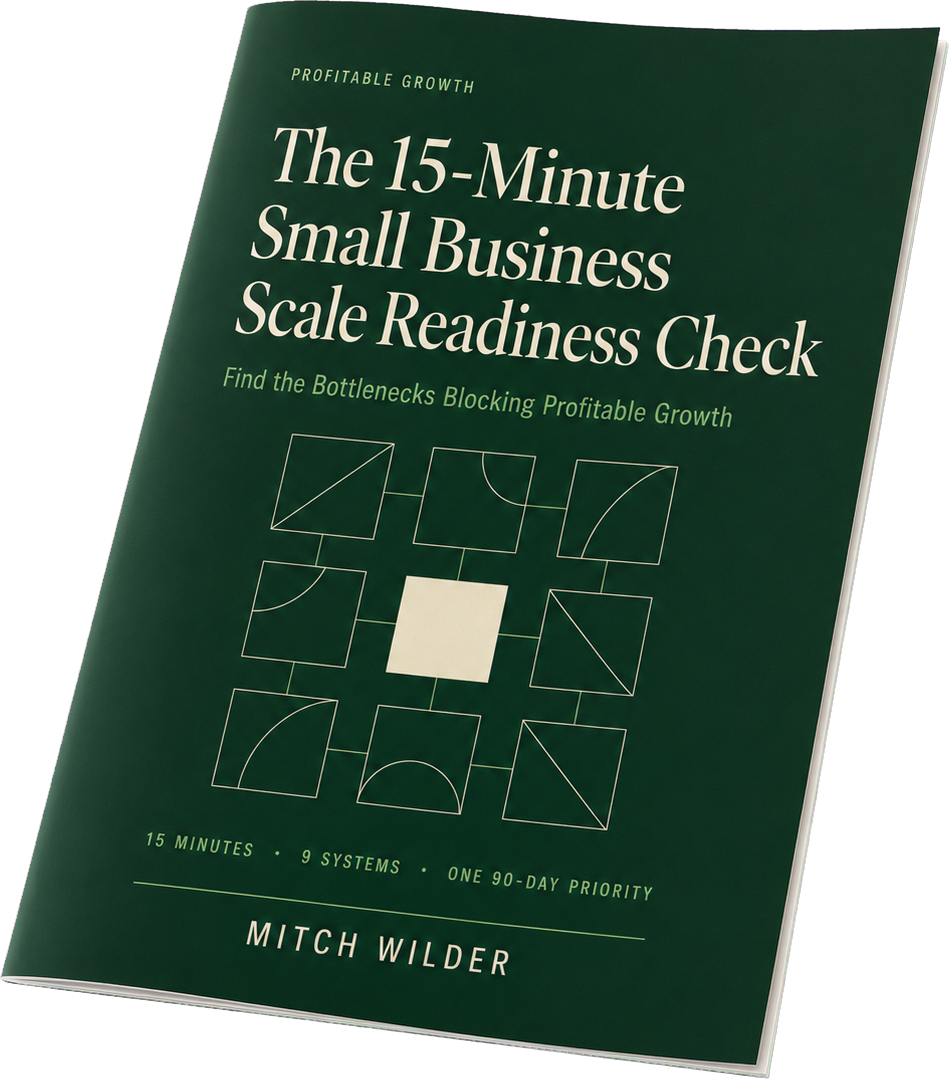
The 15-Minute Small Business Scale Readiness Check
A 45-item checklist across 9 sections that tells you whether your business is ready to scale, where your bottlenecks are, and what to fix in the next 90 days.
Get the checklistWhy Most Businesses Fail to Expand Their Reach
Most businesses don’t have an idea problem. They have a focus problem.
They Try to Reach Everyone
Broad messaging makes you forgettable. When you try to appeal to everyone, your offer gets softer, your positioning gets fuzzier, and your marketing loses relevance.
A narrow focus is best. Plain and simple.
They Use Too Many Channels at Once
One of the things that I noticed is that small teams often confuse activity with progress. Posting on six platforms, testing three ad channels, sending emails, attending events, and trying partnerships all at once usually creates scattered execution.
It’s better to dominate two or three channels than dabble in ten.
They Confuse Attention With Revenue
Impressions do not pay the bills. Followers do not automatically become customers. Traffic without conversion is just expensive noise.
Track the numbers that matter:
- Leads
- Sales calls booked
- Conversion rate
- Cost per lead
- Customer acquisition cost
- Lifetime value
They Do Accidental Marketing
Accidental marketing is when a business tries random tactics without a clear audience, message, offer, channel strategy, or measurement system.
That leads to:
- Unclear positioning
- Inconsistent messaging
- Poor campaign tracking
- Weak lead generation
- Team confusion
Before You Expand, Fix Your Foundation
Before you try to increase business visibility, fix the stuff underneath it. More traffic on a weak offer just means you lose money faster.
Audit Your Current Reach
Start with a simple audit. Ask:
- Where do most of our leads come from?
- Which channels produce actual customers?
- Which campaigns created revenue?
- Which activities take time but produce little return?
- Which audience segments buy fastest?
- Which customers refer others?
- What offers get the strongest response?
Identify Your Best Current Customers
Look at the customers who are:
- Highest paying
- Most profitable
- Easiest to serve
- Most likely to buy again
- Most likely to refer
- Most aligned with the value you provide
Your next growth move should usually come from doing more for people like them.
Clarify the Core Offer
Before you expand your business reach, be clear on:
- Who the offer is for
- What problem it solves
- Why it’s different
- What outcome it creates
- Why now matters
- What proof supports the claim
Reach Foundation Checklist
Before you scale, confirm you have:
- A clear target audience
- A strong positioning statement
- A specific offer
- A defined customer journey
- A working lead capture system
- A CRM or tracking tool
- A simple ROI dashboard
- A sales follow-up process
- At least one proven channel
The R.E.A.C.H. Framework
The takeaway is this: if you want to expand business reach in a way that actually drives growth, use a structured system.
- R — Refine your audience
- E — Elevate your message
- A — Activate the right channels
- C — Create partnerships and content distribution
- H — Harness data, conversion, and retention
Step 1 — Refine Your Target Audience
You expand faster when you stop trying to reach everyone and start reaching the people most likely to buy, stay, and refer.
Build or Revisit Your Customer Avatar
Ask:
- Who has the urgent problem we solve?
- Who has the budget?
- Who already understands the value?
- Who is easiest to reach?
- Who is most likely to become a repeat customer?
- Who influences the buying decision?
- What does this person search for online?
- What objections stop them from buying?
Segment Your Market
Score segments using this framework:
| Segment Criteria | Question to Ask |
|---|---|
| Profitability | Will this audience generate enough revenue? |
| Urgency | Do they need the solution now? |
| Accessibility | Can we reach them through existing channels? |
| Competition | Is the market overcrowded? |
| Referral Potential | Will they recommend us? |
| Retention Potential | Will they stay or buy again? |
Choose One Primary Expansion Audience
For the next 90 days, pick one primary audience.
Instead of saying, “We help small businesses,” say something like:
We help local service businesses generating $500K to $2M per year build predictable lead generation systems without wasting money on random ads.
That level of specificity creates alignment across marketing, sales, content, and partnerships.
Step 2 — Elevate Your Message
If your message is vague, expanding your reach just spreads confusion faster.
Create a Clear Positioning Statement
Use this formula:
We help [specific audience] achieve [specific outcome] without [specific pain or obstacle].
Examples:
- We help e-commerce brands increase repeat purchases without relying only on paid ads.
- We help local contractors generate qualified leads without wasting money on low-intent traffic.
- We help B2B service firms turn website visitors into booked sales calls.
Speak to the Problem, Not Just the Product
Customers do not wake up wanting “marketing services.” They want predictable leads, better ROI, less chaos, and a business that feels more under control.
In other words, sell the outcome and the problem solved, not just the deliverable.
Build a Message Map
| Message Element | What to Define |
|---|---|
| Problem | What pain does the customer feel? |
| Cost of Inaction | What happens if they do nothing? |
| Desired Outcome | What result do they want? |
| Mechanism | How do you help them get there? |
| Proof | Why should they trust you? |
| CTA | What should they do next? |
Make Your CTA Specific
Weak CTAs create weak action.
Better options:
- Get a free growth audit
- Download the 1-page reach expansion plan
- Book a 20-minute strategy call
- Calculate your marketing ROI
Step 3 — Activate the Right Marketing Channels
You do not need every channel. You need the right mix based on your audience, offer, and sales cycle.
Use the Right Channel Mix
Think in five buckets:
- Owned: website, email list, CRM, blog, podcast, YouTube
- Earned: SEO, reviews, testimonials, guest features, word of mouth
- Paid: Google Ads, Meta Ads, LinkedIn Ads, YouTube Ads, retargeting
- Shared: LinkedIn, Instagram, Facebook, Reddit, YouTube, industry groups
- Partner: referral partners, consultants, associations, complementary providers
Channel Selection Matrix
| Channel | Best For | Speed | Cost | Best Metric |
|---|---|---|---|---|
| SEO | Long-term demand capture | Slow | Medium | Organic leads |
| Paid Search | High-intent leads | Fast | High | Cost per lead |
| B2B authority | Medium | Low/Medium | Conversations booked | |
| Nurturing and retention | Medium | Low | Clicks and revenue | |
| Partnerships | Trust-based growth | Medium | Low | Referrals |
| Local SEO | Local visibility | Medium | Low | Calls and direction requests |
| Content Marketing | Authority and education | Slow/Medium | Medium | Leads and assisted conversions |
| Retargeting | Re-engaging warm prospects | Fast | Medium | Conversion rate |
Choose 2 to 3 Primary Channels
My rule is simple:
- Pick one demand capture channel
- Pick one authority channel
- Pick one relationship channel
Example:
- Demand capture: SEO
- Authority: LinkedIn
- Relationship: Email
That is a lot more powerful than doing mediocre work everywhere.
Step 4 — Use SEO to Reach People Already Looking for Solutions
SEO is one of the best ways to expand business reach because it puts you in front of buyers with intent.
Build Around Search Intent
Match content to how people search:
| Intent | Example Search | Content Type |
|---|---|---|
| Informational | how to expand business reach | Guide |
| Commercial | best CRM for small businesses | Comparison |
| Transactional | hire a marketing consultant | Service page |
| Local | SEO services near me | Local landing page |
Create Topic Clusters
If you want stronger organic traffic, build related content around the main topic.
Examples:
- how to create a marketing plan for small business
- ways to attract new customers
- how to measure marketing ROI
- lead generation strategies for small businesses
- customer retention strategies
Optimize for Search and Answer Engines
Make your content easy to understand and easy to extract.
- Use clear headings
- Add concise definitions
- Include tables and checklists
- Answer common questions directly
- Build internal links to related content
- Add FAQ sections
Step 5 — Create Content That Travels Beyond Your Website
Content marketing is not publishing. It is distribution.
Great content helps you reach new customers when it gets repurposed, shared, and tied to a buyer journey.
Create Authority Content
The best content types for business growth strategy usually include:
- How-to guides
- Case studies
- Comparison articles
- Templates
- Checklists
- Webinars
- Customer success stories
- Email newsletters
- Short educational videos
Repurpose One Core Idea
One strong article can become:
- 5 LinkedIn posts
- 1 email newsletter
- 1 YouTube video
- 3 short clips
- 1 downloadable checklist
- 1 webinar topic
- 1 sales enablement PDF
This is how you increase business visibility without creating everything from scratch.
Use the Problem, Plan, Proof Formula
Every strong piece of content should answer three things:
- What problem is the customer dealing with?
- What plan should they follow?
- What proof shows this works?
Step 6 — Build Strategic Partnerships
Partnerships are one of the most underused ways to expand your business reach.
Why? Because they let you borrow trust.
Identify Complementary Partners
Look for businesses serving the same audience in a different way:
- Business coaches
- Accountants
- Web designers
- SEO consultants
- CRM providers
- Industry associations
- Local chambers
- Software platforms
Look for Trigger Moments
Train partners to notice buying signals.
Examples:
- “We need more leads.”
- “Our site looks good, but it doesn’t convert.”
- “We’re spending too much on marketing.”
- “Our sales pipeline is messy.”
Use Simple Partnership Models
| Model | How It Works | Best For |
|---|---|---|
| Mutual Referral | You refer clients to each other | Similar-sized businesses |
| Flat Referral Fee | Partner gets a fixed payment | Simple referrals |
| Revenue Share | Partner earns a percentage | High-trust relationships |
| Co-Marketing | Shared events or content | Audience growth |
| Affiliate Partnership | Commission on tracked sales | Scalable offers |
Step 7 — Improve Conversion Before Driving More Reach
This is where a lot of businesses get burned. They try to expand reach before fixing conversion.
If your funnel leaks, more traffic just makes the leak more expensive.
Strengthen Your Website
Make sure your site has:
- A clear headline
- A specific audience
- A clear offer
- Strong proof
- An obvious CTA
- Testimonials
- Case studies
- Lead capture forms
- Easy scheduling
Use Lead Magnets
Good examples:
- Free audit
- Checklist
- Calculator
- Template
- Buyer’s guide
- Webinar
- Assessment
Align Marketing and Sales
Marketing and sales are very closely intertwined. Marketing creates demand. Sales converts demand into revenue. If the handoff is messy, reach gets wasted.
Step 8 — Measure Reach, Impact, and ROI
If you cannot measure it, you cannot scale it.
Track Metrics Across the Funnel
| Funnel Stage | Metrics to Track |
|---|---|
| Awareness | Impressions, reach, search visibility, website traffic |
| Engagement | Time on page, comments, shares, email signups |
| Lead Generation | Form fills, calls, booked consultations, downloads |
| Sales | Close rate, revenue, average order value |
| Efficiency | Cost per lead, CAC, conversion rate |
| Retention | Repeat purchase rate, churn, lifetime value |
| Referral | Referral volume, referral revenue, partner revenue |
Use a Simple Marketing ROI Formula
Marketing ROI = (Revenue from Marketing − Marketing Cost) ÷ Marketing Cost
That one number won’t tell you everything, but it will keep you honest. For a full walkthrough — what counts as marketing cost, ROI vs ROAS, and how to attribute revenue — see the deeper guide on how to measure marketing ROI. As a budgeting benchmark, the U.S. Small Business Administration suggests businesses under $5M in revenue spend about 7-8% of revenue on marketing.
Create a Weekly Dashboard
Track:
- Website traffic
- Organic search clicks
- Social reach
- Email subscribers
- Leads generated
- Sales calls booked
- New customers
- Revenue
- Cost per lead
- Conversion rate
- Referral leads
Then scale what drives qualified leads and revenue. Cut what burns time without results.
A 30-60-90 Day Plan to Expand Your Business Reach
First 30 Days — Clarify and Audit
- Audit current channels
- Identify best customers
- Choose one primary audience
- Clarify your positioning
- Review website conversion path
- Clean up tracking
- Choose 2 to 3 channels
- Define baseline metrics
Days 31–60 — Build and Test
- Publish one cornerstone guide
- Repurpose it across your channels
- Launch one lead magnet
- Start one email nurture sequence
- Contact 10 referral partners
- Test one SEO or paid initiative
- Improve one landing page
- Collect testimonials
Days 61–90 — Scale What Works
- Review channel performance
- Double down on the best channel
- Formalize partner referrals
- Publish supporting content
- Improve conversion points
- Add retargeting if traffic supports it
- Create a quarterly ROI report
The goal of the first 90 days is not to do everything. The goal is to find the few activities that create measurable reach, qualified leads, and revenue.
Common Mistakes to Avoid
- Expanding before product-market fit
- Chasing vanity metrics
- Spreading the team too thin
- Ignoring retention
- Not tracking ROI
- Copying competitors blindly
- Sending traffic to weak offers
- Treating marketing and sales as separate systems
Quick Examples of Business Reach Expansion
Local Service Business
A local contractor can grow by improving Google Business Profile, building city pages, collecting reviews, partnering with real estate agents, and tracking calls and estimates.
B2B Consulting Firm
A consultant can grow by niching down, publishing LinkedIn thought leadership, hosting partner webinars, building case studies, and tracking booked strategy calls.
E-Commerce Brand
An e-commerce brand can expand beyond paid ads by investing in SEO content, referral marketing, post-purchase email flows, influencer partnerships, and retargeting.
Business Reach Expansion Checklist
Before you expand your business reach, confirm:
- You know your ideal customer
- You understand their urgent problem
- Your offer is clear
- Your positioning is specific
- Your website converts
- Your CRM or tracking system is in place
- You know your best-performing channels
- You selected 2 to 3 focus channels
- You have a content distribution plan
- You have a referral or partnership strategy
- You are tracking leads, CAC, and ROI
- Your team understands the plan
- You review results weekly
Frequently Asked Questions About Expanding Business Reach
What does it mean to expand business reach?
It means increasing the number of relevant potential customers who become aware of, engage with, and can buy from your business. Strong reach should produce measurable business outcomes, not just visibility.
How can a small business expand its reach?
A small business can expand its reach by refining its target audience, improving its message, using SEO, creating content, building referral partnerships, improving local SEO, and tracking ROI.
What is the fastest way to reach new customers?
Usually paid search, referral partnerships, direct outreach, and local SEO improvements. But speed only matters if your offer and conversion process are strong.
How do I expand business reach without a big budget?
Focus on low-cost channels like SEO, email marketing, customer reviews, partnerships, guest appearances, local networking, and repurposed content.
What is the difference between reach and impact?
Reach is exposure. Impact is the business result created by that exposure, such as leads, sales, referrals, and revenue.
How many marketing channels should I use to expand reach?
Most businesses should choose 2 to 3 primary channels: one demand-capture channel, one authority channel, and one relationship channel. Dominating a few beats dabbling in ten.
Final Thoughts: Expand With Focus, Not Noise
If you want to expand business reach, don’t start by doing more random marketing. Start by getting more precise.
Refine your audience. Elevate your message. Activate the right channels. Create content that travels. Build partnerships. Improve conversion. Measure ROI. It all ties back to the bigger playbook for scaling a small business.
My point is this: more reach only matters when it reaches the right people and turns into real business results.