Leveraging Technology to Accelerate Business Growth

Mitch Wilder
Entrepreneur & Systems Thinker

A lot of businesses do not have a technology problem. They have a strategy problem.
They buy software, test AI tools, run ads, collect data, and stack up subscriptions, but none of it connects to a simple growth system. Then they wonder why revenue feels inconsistent, follow-up is messy, and marketing ROI is still fuzzy.
If you want to use technology for business growth without wasting money, the way that I look at it is pretty simple: start with the bottleneck, not the tool. Technology works when it helps you attract leads, convert customers, retain buyers, and measure what is actually driving growth.
Quick answer
Technology accelerates business growth when it is tied to a specific bottleneck rather than bought for its own sake. Start with a CRM to manage leads and follow-up, add marketing automation to respond faster, use analytics to measure ROI, and layer in AI, project management, and customer-experience tools only where they solve a measurable problem your team will actually use.
This kind of disciplined investment pays off, but the base rate is sobering: roughly half of small businesses fail within five years (U.S. Bureau of Labor Statistics). A tight, well-adopted tech stack is one of the cheapest ways to improve those odds — because retention alone is powerful, and acquiring a customer costs five to 25 times more than retaining one (Harvard Business Review).
Key Takeaways
- Technology for business growth works best when it is tied to a specific business goal.
- The biggest growth gaps usually show up in lead generation, follow-up, conversion, retention, and reporting.
- A CRM is often the best first investment because it connects marketing, sales, and customer data.
- Automation saves time, but only if the underlying process already makes sense.
- Analytics matter because they show which channels, campaigns, and offers are producing revenue.
- AI is a force multiplier, not a replacement for strategy, judgment, or customer understanding.
- The best tech stack is usually smaller than people think and simpler than vendors want you to believe.
- If your team will not use the tool, it is not the right tool.
What Does “Technology for Business Growth” Really Mean?
Technology for business growth is the use of digital tools, automation, data, and software systems to help a business increase revenue, attract customers, improve operations, and scale more efficiently.
In other words, it is not just buying software. It is building systems.
That can include:
- Attracting better leads
- Improving sales follow-up
- Automating repetitive tasks
- Tracking marketing performance
- Reducing operational bottlenecks
- Improving customer experience
- Making better decisions with data
My point is this: technology does not fix a broken strategy. It amplifies the strategy you already have. If your offer is weak, your message is unclear, or your sales process is sloppy, more tools will not save you. They may just help you fail faster. Think of it as part of your broader strategy for scaling a small business, not a shortcut around one.
How does technology help business growth?
Technology helps business growth by improving lead generation, automating repetitive work, tracking marketing ROI, strengthening customer relationships, increasing sales efficiency, and giving owners better data for decision-making. The most effective systems are tied to a clear outcome like more customers, higher revenue, better retention, or less wasted time.
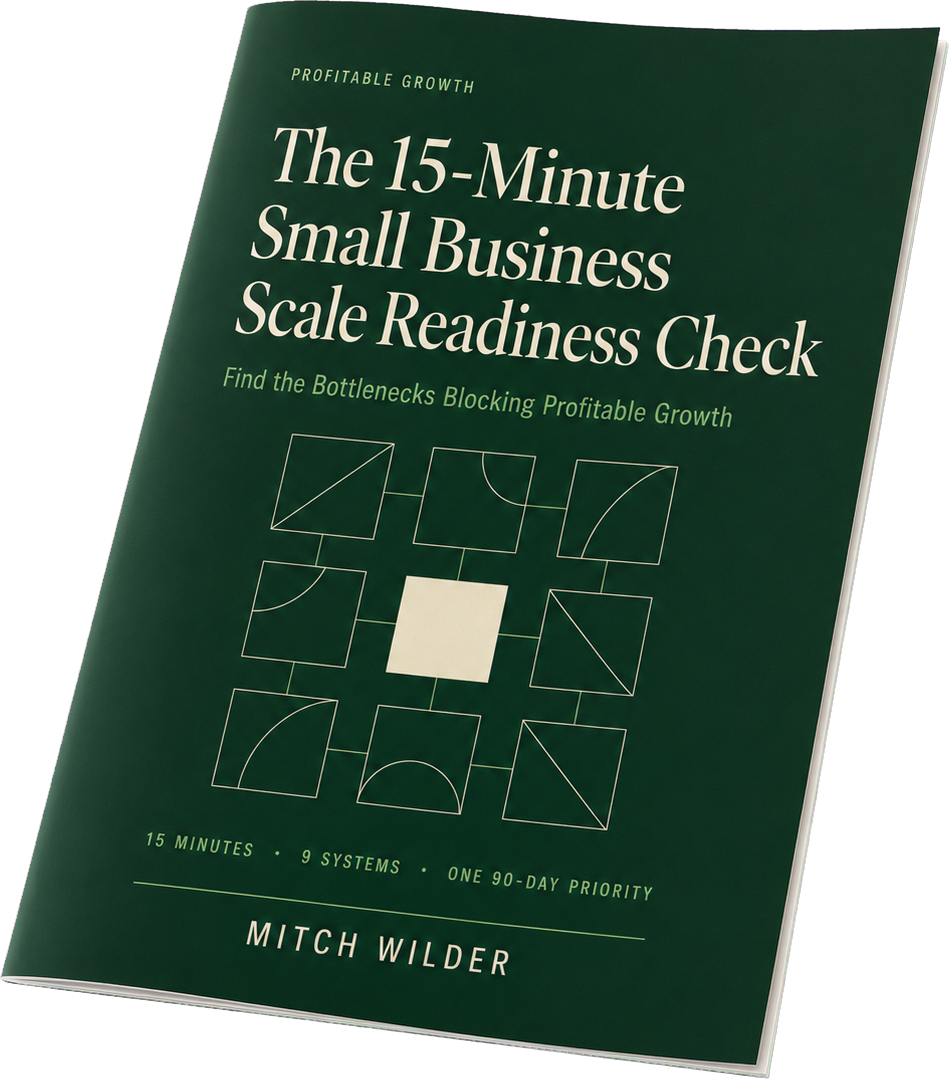
Free checklist
The 15-Minute Small Business Scale Readiness Check
A 45-item checklist across 9 sections that tells you whether your business is ready to scale, where your bottlenecks are, and what to fix in the next 90 days.
Get the checklistWhy Technology Matters for Small Business Growth
Most businesses stall in one of five places:
- Not enough qualified leads
- Poor follow-up
- Low conversion rates
- Weak customer retention
- No visibility into what is working
Technology can improve every one of those areas if you use it with intent.
It helps you stop accidental marketing
A lot of small businesses market randomly. They post when they remember, send emails inconsistently, run ads without clean tracking, and rely too heavily on referrals.
Technology creates repeatability. Instead of guessing what worked, you can see which campaign drove leads, which leads turned into customers, and which customers generated the most revenue.
It gives you more control over growth
Dashboards reduce guesswork. CRMs show pipeline health. Analytics reveal lead sources. Automation makes follow-up less dependent on memory.
That control matters because growth gets very expensive when you are operating blind.
It helps you scale without more chaos
Growth without systems usually feels like stress, not success. Right?
Technology helps teams execute the same process, track handoffs, and reduce operational drag.
| Growth Problem | Technology Solution |
|---|---|
| Leads are inconsistent | CRM + lead capture + email automation |
| Follow-up is manual | Sales automation |
| Marketing ROI is unclear | Analytics dashboard |
| Customers churn | Retention system |
| Team is scattered | Project management software |
The 7 Best Ways to Use Technology to Accelerate Business Growth
1. Use a CRM to Manage Leads, Customers, and Sales Opportunities
A CRM is the foundation of business growth technology because it keeps leads and customers from falling through the cracks.
A good CRM tracks:
- Leads
- Prospects
- Customers
- Sales conversations
- Follow-up tasks
- Deals in progress
- Customer history
Why does this matter? Because follow-up is where a lot of revenue dies.
If marketing and sales are closely intertwined, your CRM is the bridge between the two. Tools like HubSpot, Salesforce, Zoho CRM, Pipedrive, and Keap can all work, depending on your size and sales process — see this comparison of the best CRM tools for small businesses if you are choosing one.
A simple example: a local service business captures website leads into a CRM, assigns them automatically, triggers a confirmation email, and tracks every next step in the pipeline.
If your CRM cannot answer these questions, it is probably not set up correctly:
- Where did this lead come from?
- Who owns the follow-up?
- What is the next action?
- How much pipeline revenue is open?
- Which channels produce the best customers?
2. Use Marketing Automation to Follow Up Faster
Most businesses do not lose leads because the leads are bad. They lose leads because follow-up is slow, inconsistent, or irrelevant. That speed advantage is measurable: firms that respond to a lead within an hour are about seven times more likely to qualify it (Harvard Business Review) — exactly the kind of delay automation removes.
Marketing automation helps you send the right message at the right time. That might include:
- Welcome emails
- Lead nurture sequences
- Appointment reminders
- Abandoned cart emails
- Onboarding emails
- Re-engagement campaigns
- Referral requests
One of the things that I noticed is that automation becomes powerful when it reduces delay. A prospect downloads a guide, gets a welcome email, then a case study, then a useful article, then an invitation to book a call. That sequence keeps momentum moving and strengthens your broader lead generation strategy.
Tools like ActiveCampaign, Mailchimp, Klaviyo, ConvertKit, and HubSpot can handle this well.
The warning is obvious but important: do not over-automate. Automation should still feel useful and human. Segment by behavior, personalize when possible, and avoid generic spam.
3. Use Analytics to Measure Marketing ROI
If you cannot measure it, you cannot manage it. Plain and simple.
Analytics help you understand:
- Where traffic comes from
- Which campaigns generate leads
- Which channels create customers
- Which pages convert
- Which ads waste money
- Which offers produce revenue
The goal is not to track everything. The goal is to track the few numbers that tell you whether your marketing is profitable. For the full method, see this guide on how to measure marketing ROI.
| Metric | What It Tells You |
|---|---|
| Website traffic | How many people visit your site |
| Conversion rate | How many visitors take action |
| Cost per lead | What it costs to generate a lead |
| Customer acquisition cost | What it costs to win a customer |
| Lifetime value | What a customer is worth over time |
| Return on ad spend | Revenue generated from ads |
| Sales close rate | Percentage of leads that become customers |
Google Analytics, Search Console, Looker Studio, Shopify analytics, Meta Ads Manager, and Databox are solid options here.
How can technology improve marketing ROI? Technology improves marketing ROI by showing which campaigns generate leads, customers, and revenue. That helps you cut low-performing channels and invest more in what is actually working.
4. Use AI Tools to Improve Speed and Decision-Making
AI can absolutely help small businesses move faster. I think that part is real.
What is not real is the idea that AI is your strategy.
AI tools can support:
- Market research
- Content outlines
- Email drafts
- Sales scripts
- Customer support responses
- Review analysis
- Competitor research
- Internal documentation
- Meeting summaries
Useful tools include ChatGPT, Claude, Gemini, Perplexity, Notion AI, Grammarly, Fireflies, and Fathom.
Good use cases are practical. For example:
- Generate subject lines for a retention email
- Summarize customer reviews into common pain points
- Pull objections out of sales call notes
- Draft FAQ answers for support
- Turn one article into multiple social post angles
But here is the rule: verify facts, protect customer data, and keep the brand voice human. AI is a force multiplier for businesses that already understand their market.
5. Use Project Management Tools to Improve Execution
Growth slows down when work lives in inboxes, Slack threads, and somebody’s head.
Project management tools create visibility around campaigns, launches, deadlines, and responsibilities. That includes:
- Campaign planning
- Task assignment
- Content calendars
- Product launches
- Client delivery
- Internal workflows
Tools like Asana, ClickUp, Monday.com, Trello, Notion, and Basecamp can all help.
Instead of saying, “We need to launch something next month,” you build a board with the offer, audience, landing page tasks, email sequence, ad creative, owner, due date, and KPI target.
That sounds simple because it is simple. And simple systems usually outperform chaotic smart people.
6. Use Customer Experience Technology to Improve Retention
Business growth is not just about getting new customers. It is also about keeping the ones you already earned.
Customer experience technology supports:
- Faster support
- Personalized communication
- Satisfaction surveys
- Review generation
- Referral requests
- Churn prevention
Tools like Zendesk, Help Scout, Intercom, Freshdesk, Typeform, SurveyMonkey, and review platforms help here.
A strong post-purchase flow might include:
- Thank-you email
- Onboarding checklist
- Satisfaction survey
- Follow-up resource
- Review request
- Referral request
How does technology improve customer retention? Technology improves customer retention by helping businesses communicate consistently, respond quickly, personalize support, collect feedback, and spot risk before a customer leaves — the backbone of most customer retention strategies.
7. Use E-Commerce and Payment Technology to Remove Buying Friction
The easier it is to buy from you, the more revenue you tend to keep.
Buying friction usually looks like:
- Complicated checkout
- Slow pages
- Weak mobile experience
- Limited payment options
- Confusing product pages
- No abandoned cart follow-up
Shopify, WooCommerce, Stripe, Square, PayPal, Apple Pay, and Google Pay reduce that friction.
For e-commerce brands especially, improving checkout flow, recovering abandoned carts, and offering better payment options can lift revenue without increasing ad spend.
The Technology Growth Stack Small Businesses Actually Need
Most businesses do not need 27 tools. They need a simple stack that supports the customer journey.
| Growth Function | Technology Needed | Business Purpose |
|---|---|---|
| Attract | Website, SEO tools, ad platforms | Bring in potential customers |
| Capture | Landing pages, forms | Turn visitors into leads |
| Convert | CRM, email automation, sales tools | Turn leads into customers |
| Deliver | Project management, support, payment tools | Serve customers efficiently |
| Retain | Surveys, email, review tools | Keep customers and create referrals |
Start with the customer journey, not the software.
Ask:
- How do people discover you?
- How do they become a lead?
- What follow-up do they get?
- How do they buy?
- What happens after purchase?
- How do you retain and refer them?
A strong starter stack might include:
- Website: WordPress, Shopify, Webflow, Squarespace
- CRM: HubSpot, Pipedrive, Zoho
- Email: Mailchimp, ActiveCampaign, ConvertKit
- Analytics: Google Analytics, Search Console, Looker Studio
- Project management: Asana, Trello, ClickUp
- Payments: Stripe, Square, PayPal
How to Choose the Right Technology for Business Growth
The right tool is not the most popular one. It is the one that solves the biggest bottleneck.
Use this filter:
Step 1: Identify the bottleneck
Is the real problem:
- Not enough leads?
- Bad lead quality?
- Weak follow-up?
- Low close rate?
- Poor retention?
- Messy execution?
- Unclear ROI?
Step 2: Tie the tool to an outcome
| Business Goal | Technology Type |
|---|---|
| Generate more leads | Landing pages, SEO tools, ad platforms |
| Convert more leads | CRM, automation, sales tools |
| Save time | Workflow automation, project management |
| Improve retention | Support tools, surveys, email |
| Track ROI | Analytics dashboards |
Step 3: Check ease of use
Ask:
- Will the team actually use it?
- Does it integrate with existing tools?
- Is reporting clear?
- Does it reduce work or create more work?
Step 4: Calculate ROI first
A simple formula works:
Technology ROI = revenue gained or costs saved ÷ cost of technology
If a CRM costs $300 a month and helps you close one extra $3,000 client, the economics are not hard to understand.
Step 5: Avoid shiny object syndrome
Do not buy a tool because a competitor uses it, an influencer recommended it, or the demo looked amazing.
Buy it because it solves a measurable problem.
The G.R.O.W.T.H. Technology Framework
I like frameworks because they force clarity. Here is one that works.
| Letter | Meaning | Explanation |
|---|---|---|
| G | Goal | Start with a measurable business goal |
| R | Roadblock | Identify the bottleneck slowing growth |
| O | Options | Compare tools that solve that problem |
| W | Workflow | Build the process before automating it |
| T | Tracking | Measure revenue, time saved, and ROI |
| H | Human Adoption | Train the team so the system gets used |
The takeaway is simple: choose technology based on strategy, not software hype.
A Simple 30-Day Plan to Start
You do not need to transform everything this quarter. You need momentum.
Days 1–5: Audit your tools
- List every subscription
- Identify duplicates
- Cancel unused tools
- Document what each tool is supposed to do
Days 6–10: Find the main bottleneck
Pick one:
- More leads
- Better follow-up
- Higher conversion
- Better retention
- Cleaner reporting
- Better execution
Days 11–20: Improve one system
Choose one area like CRM setup, automation, analytics, review requests, or project management. Implement it, connect the integrations, assign ownership, and document the process.
Days 21–25: Train the team
Technology fails when adoption fails.
Set expectations, create a simple SOP, assign responsibilities, and review usage weekly.
Days 26–30: Measure and optimize
Look at early metrics:
- Time saved
- Leads generated
- Conversion rate
- Revenue influenced
- Customer retention
- Team productivity
Install less. Optimize more.
Common Technology Mistakes That Slow Growth
The biggest mistakes are predictable:
- Buying tools without a strategy
- Tracking too many metrics
- Automating a broken process
- Ignoring team adoption
- Creating a disconnected tech stack
- Forgetting about cybersecurity
Use fewer metrics, cleaner systems, and stronger ownership. Also protect customer data with basics like password managers, two-factor authentication, backups, and role-based access.
Frequently Asked Questions About Technology for Business Growth
What is the best technology for small business growth?
Usually a CRM, email platform, analytics tool, project management system, payment processor, and customer feedback tool. The best mix depends on your biggest bottleneck.
What should a small business invest in first?
For most businesses, I think the answer is a CRM. It creates visibility into leads, follow-up, pipeline value, and revenue attribution.
Can technology replace a marketing strategy?
No. Technology supports strategy. It does not replace clear positioning, a strong offer, the right audience, or a reliable sales process.
How do you know if technology is helping your business grow?
You know it is working when measurable outcomes improve, including revenue, lead quality, conversion rate, retention, time saved, response speed, or marketing ROI.
What are examples of business growth technology?
Common examples include CRM software, marketing automation platforms, analytics dashboards, project management tools, AI tools, e-commerce platforms, payment systems, customer support software, and review management tools.
How much should a small business spend on technology?
There is no fixed percentage, but tie spend to ROI: a tool should either generate more revenue or save enough time to justify its cost. Start lean, prove value on one bottleneck, then expand.
Conclusion: Use Technology as a Growth System, Not a Collection of Tools
Technology can help you attract better leads, follow up faster, close more sales, retain more customers, and make smarter decisions. But only if it connects to a clear growth strategy.
The best technology for business growth is not the flashiest platform. It is the system your team actually uses to solve a real bottleneck.
If you only do three things next, do this:
- Map your customer journey
- Identify your biggest growth bottleneck
- Choose one tool that directly improves that stage
Want to stop accidental marketing and build a more predictable growth system? Start there. One bottleneck, one system, one measurable improvement at a time.