How to Grow Business Revenue Fast: 15 Proven Strategies That Actually Work

Mitch Wilder
Entrepreneur & Systems Thinker

If you’re trying to grow business revenue and your answer so far has been “do more marketing,” I think you’re looking at the problem the wrong way.
Most businesses do not need more random tactics. They need a clearer revenue system. In other words, revenue usually grows when you fix the specific points where money is leaking out of the business: weak conversion, bad follow-up, low pricing, poor retention, or scattered channel strategy.
In this guide, I’ll show you the fastest levers to pull, what to track, and how to build a practical 90-day plan. This is one of the core sub-topics inside my broader guide on strategies for scaling a small business.
Quick answer
To grow business revenue fast, focus on the revenue levers with the shortest path to cash: improve conversion rates, raise prices strategically, reactivate past customers, increase average order value, fix follow-up, improve retention, and double down on the channels that already produce ROI. The fastest revenue is often sitting inside your current business, not outside of it.
The fastest ways to increase business revenue are:
- Sell more to your best existing customers
- Improve your lead-to-sale conversion rate
- Raise prices or repackage your offer
- Add upsells, bundles, or premium options
- Reactivate past customers and lost deals
- Shorten your sales cycle with better follow-up
- Cut low-performing marketing channels and scale winners
This matters because most new businesses do not have unlimited runway to figure it out. Roughly half of new establishments survive five years or less (U.S. Bureau of Labor Statistics), so pulling the fastest, highest-ROI levers first is not a luxury — it is survival.
Key Takeaways
- Revenue grows fastest when you fix leaks — conversion, follow-up, pricing, and retention — before buying more traffic.
- Your existing and past customers are usually the cheapest, fastest source of new revenue.
- Small, strategic price increases can create outsized gains in revenue and profit.
- Follow-up systems beat good intentions every time; most leads do not buy on the first touch.
- Increasing average order value and purchase frequency compounds revenue without new leads.
- Track revenue metrics, not vanity metrics, and scale only the channels that produce profitable ROI.
Start With the Revenue Growth Equation
Here’s the simplest way I know to think about revenue growth:
Revenue = Qualified Leads × Conversion Rate × Average Transaction Value × Purchase Frequency × Retention
Revenue growth is the increase in your company’s sales over time. Average transaction value is how much a customer spends per purchase. Customer lifetime value is the total revenue a customer generates over the full relationship.
The way that I look at it, most owners obsess over the first variable, leads. But one of the things that I noticed is that many businesses don’t actually have a lead problem first. They have a conversion, follow-up, pricing, or retention problem.
| Revenue Lever | What It Means | Fastest Way to Improve It | Metric to Track |
|---|---|---|---|
| Qualified Leads | Better-fit prospects | Tighten targeting and clarify offer | Lead quality |
| Conversion Rate | More leads becoming customers | Improve sales process and speed to lead | Close rate |
| Average Transaction Value | More revenue per sale | Upsells, bundles, premium packages | AOV or deal size |
| Purchase Frequency | Customers buying more often | Email, reminders, subscriptions | Repeat purchase rate |
| Retention | Customers staying longer | Better onboarding and service | Retention rate |
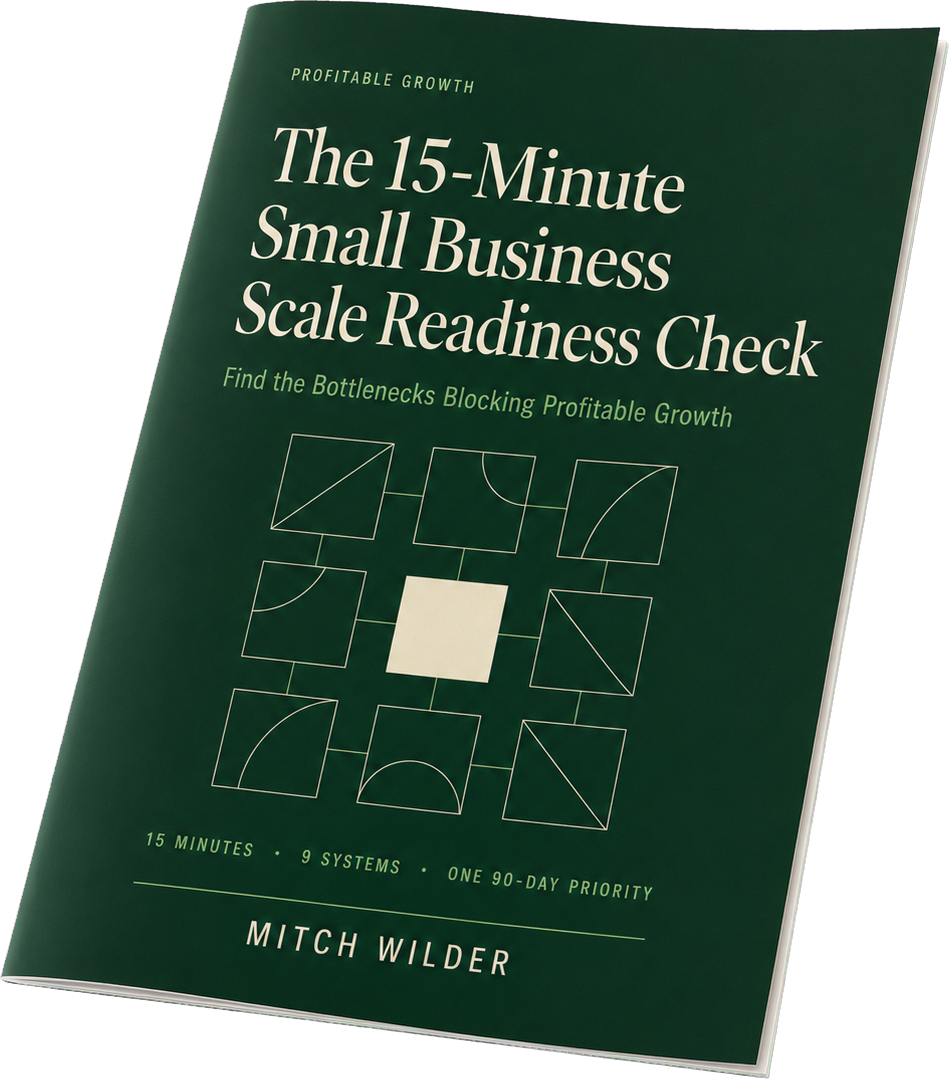
Free checklist
The 15-Minute Small Business Scale Readiness Check
A 45-item checklist across 9 sections that tells you whether your business is ready to scale, where your bottlenecks are, and what to fix in the next 90 days.
Get the checklist1. Focus on Your Most Profitable Customers First
If you’re trying to sell to everyone, you’re probably converting poorly.
The fastest path to small business revenue growth usually starts with identifying your top 20% of customers by revenue, margin, repeat behavior, and referral value. Those customers tell you where your real opportunity is.
Do this:
- Export your customer list from your CRM, Stripe, QuickBooks, or payment system
- Rank customers by total revenue
- Add gross margin if you can
- Identify patterns among your best customers
- Adjust your messaging and acquisition around that segment
For example, if your best customers are service businesses with 10 to 50 employees, stop marketing to “all small businesses.” That’s too broad to be useful.
Track:
- Customer lifetime value
- Gross margin by segment
- Close rate by segment
- Referral rate by customer type
2. Increase Prices Strategically
A lot of businesses undercharge because they’re afraid of losing deals. Right? But a small increase in pricing can create an outsized increase in revenue and profit.
The key is to raise prices intelligently, not emotionally.
Here are a few smart ways to do it:
- Test higher pricing on new customers first
- Create a premium package with faster delivery or more support
- Bundle related services into a higher-value offer
- Remove low-margin services that create operational drag
Let’s keep it simple. If a business doing $500,000 a year raises prices by 5% and keeps volume steady, that’s $25,000 in additional annual revenue. Plain and simple.
Avoid:
- Raising prices without increasing perceived value
- Discounting too quickly
- Sounding apologetic about your pricing
- Keeping low-profit offers just because you’re used to them
3. Improve Conversion Before You Buy More Traffic
If your funnel is leaking, more traffic just means more waste.
I think this is one of the most common mistakes in growth. Businesses spend more on ads, SEO, or outreach before fixing the basic question: Are we converting the attention we already have?
Improve conversion by tightening these areas:
- Make your offer clearer
- Respond to leads faster
- Add trust signals like testimonials and case studies
- Handle objections earlier
- Simplify proposals and next steps
A lead should never wonder:
- What exactly do you do?
- Is this for me?
- Why should I trust you?
- What happens next?
- What will this cost?
- What outcome should I expect?
Track:
- Visitor-to-lead conversion rate
- Lead-to-call booking rate
- Proposal-to-close rate
- Overall close rate
4. Build a Follow-Up System
Revenue gets lost in messy inboxes, forgotten DMs, and “I’ll remember to follow up later.”
You won’t.
A real follow-up system beats good intentions every time. Most leads do not buy on the first touch, so if your follow-up is random, your revenue will be random too. This is exactly why building a strong sales pipeline matters as much as generating the leads in the first place.
A simple sales pipeline might look like this:
- New lead
- Qualified
- Call booked
- Proposal sent
- Follow-up needed
- Won
- Lost
- Reactivation later
A basic 10-day follow-up sequence:
- Day 0: Immediate response
- Day 1: Helpful follow-up
- Day 3: Share proof or a case study
- Day 5: Address objections
- Day 7: Direct check-in
- Day 10: Final value-based follow-up
Tools like HubSpot, Pipedrive, Zoho CRM, Salesforce, ActiveCampaign, and GoHighLevel can help, but the takeaway is this: software helps only after the process is clear.
5. Increase Average Order Value
One of the fastest ways to grow business revenue is to increase how much each customer spends.
There are three easy levers here:
- Upsell: a higher-value version of the main offer
- Cross-sell: a related product or service
- Bundle: multiple items packaged together
| Business Type | Upsell Example | Cross-Sell Example | Bundle Example |
|---|---|---|---|
| Agency | Premium strategy package | CRM setup | Growth package |
| E-commerce | Larger quantity | Accessory | Starter kit |
| Consultant | VIP intensive | Training or templates | Strategy + implementation |
| SaaS | Higher plan | Add-on feature | Annual plan with onboarding |
Start with your most common purchase. Then ask: what does the customer naturally need next?
Track:
- Average order value
- Deal size
- Upsell conversion rate
- Bundle conversion rate
6. Reactivate Past Customers and Lost Deals
The fastest revenue is often found in customers, leads, and opportunities you already have.
Past customers already know you. Lost deals already considered you. Warm prospects are dramatically easier to convert than cold ones.
Run a 7-day reactivation sprint:
- Day 1: Pull past customers, lost deals, and inactive leads
- Day 2: Segment by reason they went quiet
- Day 3: Create one offer per segment
- Day 4: Send email one
- Day 5: Follow up with a useful resource
- Day 6: Call or message high-value prospects
- Day 7: Review and book next steps
Simple campaign angles:
- “Still need help with this?”
- “Should we revisit this?”
- “Is this still a priority?”
This works because trust is already present. You’re not starting from zero.
7. Improve Retention and Purchase Frequency
Acquisition matters, but retention multiplies everything.
The economics back this up: research published in Harvard Business Review found that increasing customer retention rates by just 5% can increase profits by 25% to 95%. Few acquisition tactics come close to that kind of leverage.
If customers stay longer and buy more often, revenue becomes more stable, margins improve, and your dependence on constant lead generation drops. For a deeper playbook, see my guide on how to increase customer retention and loyalty.
Practical retention strategies:
- Improve onboarding so customers get value quickly
- Schedule regular check-ins
- Add loyalty incentives
- Create subscriptions or maintenance plans
- Monitor churn signals early
| Business Type | Retention Strategy |
|---|---|
| E-commerce | Replenishment emails and loyalty rewards |
| B2B service | Quarterly business reviews |
| SaaS | Onboarding and success check-ins |
| Consulting | Monthly advisory retainers |
| Local business | Membership or maintenance plans |
Track:
- Retention rate
- Churn rate
- Repeat purchase rate
- Revenue from existing customers
8. Create a Referral System
Word of mouth is great. Passive referrals are not a strategy.
The best referral systems are specific, easy, and consistent. Ask after a successful outcome, not randomly.
Instead of saying, “Know anyone?” say this:
“Do you know one other business owner who is trying to improve their marketing ROI this quarter?”
Make it easy to refer you with:
- A short intro email template
- A referral link
- A one-sentence description of who you help
- A thank-you gift or incentive
Also look at referral partners like accountants, coaches, web designers, CRM consultants, and financial planners. These relationships can produce high-trust leads for years.
9. Align Marketing and Sales Around Revenue
Marketing without sales alignment creates noise. Sales without marketing alignment creates blame.
Revenue growth becomes predictable when marketing, sales, pricing, and retention are managed as one system. That means shared definitions, shared metrics, and shared accountability.
Start here:
- Define what a qualified lead actually is
- Use one shared pipeline
- Hold a weekly revenue meeting
- Review revenue by source, not just leads by source
Your dashboard should include:
- Revenue
- Leads
- Conversion rate
- Cost per lead
- Customer acquisition cost
- Sales cycle length
- Close rate
- Marketing ROI
10. Double Down on High-ROI Channels
Stop doing accidental marketing.
Not every channel deserves your time. The way that I look at it, your job is not to be everywhere. Your job is to identify which channels reliably create profitable revenue and scale those. If you’re unsure which channels move the needle, start by learning how to measure marketing ROI.
| Business Situation | Best Channel to Test First |
|---|---|
| You have a list but low repeat sales | Email marketing |
| You need high-intent leads | Google search or SEO |
| You sell B2B services | LinkedIn and referrals |
| You have traffic but low conversions | Retargeting and landing page optimization |
| You have happy customers | Referral campaigns |
Track:
- Revenue by channel
- Cost per acquisition
- Return on ad spend
- Lead quality
- Marketing ROI
11. Create a Clearer Offer
Confused buyers do not buy.
A stronger offer can grow revenue without changing the product itself. You just make the value easier to understand and easier to say yes to.
A strong offer should clearly answer:
- Who is this for?
- What painful problem does it solve?
- What outcome does it create?
- How does it work?
- Why should I trust you?
- What reduces my risk?
- What do I do next?
Weak offer:
“We provide marketing services for small businesses.”
Stronger offer:
“We help service-based small businesses build a 90-day lead generation system that tracks ROI and turns more leads into booked sales calls.”
That second version sells the outcome, not the category.
12. Track the Numbers That Actually Grow Revenue
Vanity metrics make people feel busy. Revenue metrics make people better.
You should know exactly how prospects move from lead to customer and where the drop-off happens.
Here’s a simple revenue dashboard:
| Metric | Why It Matters |
|---|---|
| Total revenue | Shows top-line growth |
| Gross margin | Shows profitable revenue |
| Leads generated | Measures demand |
| Conversion rate | Measures sales effectiveness |
| Average deal size | Measures transaction value |
| CAC | Measures cost efficiency |
| Customer lifetime value | Measures long-term value |
| Retention rate | Measures stability |
| Marketing ROI | Shows what to scale |
Weekly questions to ask:
- What generated revenue this week?
- Which leads were highest quality?
- Where are prospects dropping off?
- Which channel produced the best ROI?
- What should we stop doing?
- What should we double down on?
Your 30-60-90 Day Revenue Growth Plan
If you only do three things after reading this, make them structured and time-bound.
First 7 Days: Find the Leaks
- Review revenue by product, service, and customer segment
- Identify your top customers
- Review open leads and stale proposals
- Check pricing and margin
- Identify your best-performing marketing channel
Days 8-30: Capture Quick Wins
- Follow up with open leads
- Launch a reactivation campaign
- Add one upsell or bundle
- Improve your offer page
- Test a price increase for new customers
- Ask happy customers for referrals
Days 31-60: Build the System
- Clean up or implement your CRM
- Create a weekly revenue dashboard
- Align sales and marketing definitions
- Improve email nurture and follow-up
- Tighten proposals and objection handling
Days 61-90: Scale What Works
- Put more budget into top-performing channels
- Expand referral partnerships
- Launch retargeting
- Improve retention campaigns
- Remove low-margin offers
Common Mistakes That Kill Revenue Growth
A few mistakes show up over and over:
- Chasing more traffic before fixing conversion
- Discounting instead of increasing value
- Ignoring existing customers
- Tracking activity instead of revenue
- Using too many channels at once
- Letting leads go cold
- Growing revenue without watching profit
My point is this: top-line growth is nice, but profitable, repeatable growth is what actually matters.
When Should You Hire Help?
You should consider outside help when:
- You’re spending on marketing but can’t track ROI
- Lead flow is inconsistent
- Sales and marketing are misaligned
- You have leads but low conversion
- You don’t have a CRM or follow-up process
- Revenue has plateaued
- You’re too close to the business to see the bottleneck clearly
A revenue growth consultant can help with:
- Revenue audits
- Offer positioning
- Pricing strategy
- CRM implementation
- Sales funnel analysis
- Retention campaigns
- ROI tracking
- A focused 90-day plan
Before hiring anyone, ask:
- How will success be measured?
- Which revenue levers will you evaluate first?
- What quick wins do you usually find?
- How do you track ROI?
- What does the first 30 days look like?
Frequently Asked Questions About Growing Business Revenue
How can a business increase revenue quickly?
The fastest ways are usually improving follow-up, raising prices strategically, reactivating past customers, adding upsells, and improving conversion rates before increasing ad spend.
What are the four main ways to grow revenue?
Acquire more customers, increase average transaction value, increase purchase frequency, and improve retention. Most businesses should optimize these before chasing more traffic.
How do I grow revenue without spending more on ads?
Improve conversion, follow up with open leads, increase prices, launch referral campaigns, improve retention, and reactivate old customers. These are usually lower-cost and faster-return actions.
Should I lower prices to increase revenue?
Usually no. Lowering prices can hurt margin and positioning. In many cases, increasing value, improving packaging, or creating premium options works better.
Is revenue growth the same as profit growth?
No. Revenue is top-line sales. Profit is what remains after expenses. You can grow revenue while hurting profit if costs or discounting rise too fast.
Conclusion: Grow Revenue With Focus, Not More Noise
You do not grow business revenue by doing everything. You grow it by identifying the highest-impact levers and fixing them in the right order.
Start with the leaks. Improve conversion before traffic. Raise prices with confidence. Sell more to existing customers. Build real follow-up. Track ROI every week.
That’s how revenue growth stops feeling random and starts becoming manageable.