How to Align Leadership With Marketing Goals

Mitch Wilder
Entrepreneur & Systems Thinker

Your marketing may not be failing because the tactics are bad. It may be failing because your leadership team is not aligned on what marketing is supposed to accomplish.
I see this constantly. The founder wants growth. Sales wants better leads. Marketing wants budget and time. Finance wants proof. Operations wants fewer surprises. Everyone is making valid points, but nobody is operating from one shared system. That is how businesses end up with busy marketing, scattered priorities, and weak ROI.
If you want to align leadership marketing goals, you do not need more opinions. You need a simple framework that connects business goals, customer acquisition, sales process, KPIs, ownership, and review cadence.
Quick answer
To align leadership with marketing goals, start with the company’s business objective, identify the main growth constraint, define the target customer, agree on the offer and message, choose the right channels, set clear KPIs, assign owners, and review performance on a consistent cadence. Plain and simple, leadership alignment turns marketing from random activity into a business growth system.
Key Takeaways
- Most marketing problems are actually leadership alignment problems.
- Marketing goals should come from business goals, not random channel ideas.
- Sales and marketing alignment is critical because lead generation and conversion are part of the same revenue system.
- A one-page plan is usually more useful than a 40-page strategy document.
- Leadership should agree on the customer, offer, message, channel, KPI, owner, and review rhythm.
- Vanity metrics create confusion; leadership needs business-facing marketing KPIs.
- A goal without ownership is just a wish.
- Weekly, monthly, and quarterly reviews keep the team aligned over time.
What Does It Mean to Align Leadership With Marketing Goals?
Leadership alignment means the team agrees on what marketing is responsible for, how success will be measured, who owns each part of the plan, and how marketing supports the company’s larger business goals.
The way that I look at it, fake alignment sounds like this:
- We need more leads
- We should post more content
- We need better ads
- We should be on LinkedIn
- Let’s test a new channel
That is not strategy. That is activity.
Real alignment means leadership agrees on the business goal, the primary growth constraint, the target customer, the offer, the message, the main channels, the budget, the KPIs, the owners, and the review cadence. In other words, marketing stops being a list of tasks and starts becoming a system — the same system behind any working small business marketing plan.
This is not a soft, feel-good exercise. It is a growth lever. Forrester found that firms with high levels of alignment across customer-facing functions report 2.4x higher revenue growth and 2x higher growth in profitability than those without alignment (Forrester). Alignment is one of the cheapest ways to grow faster.
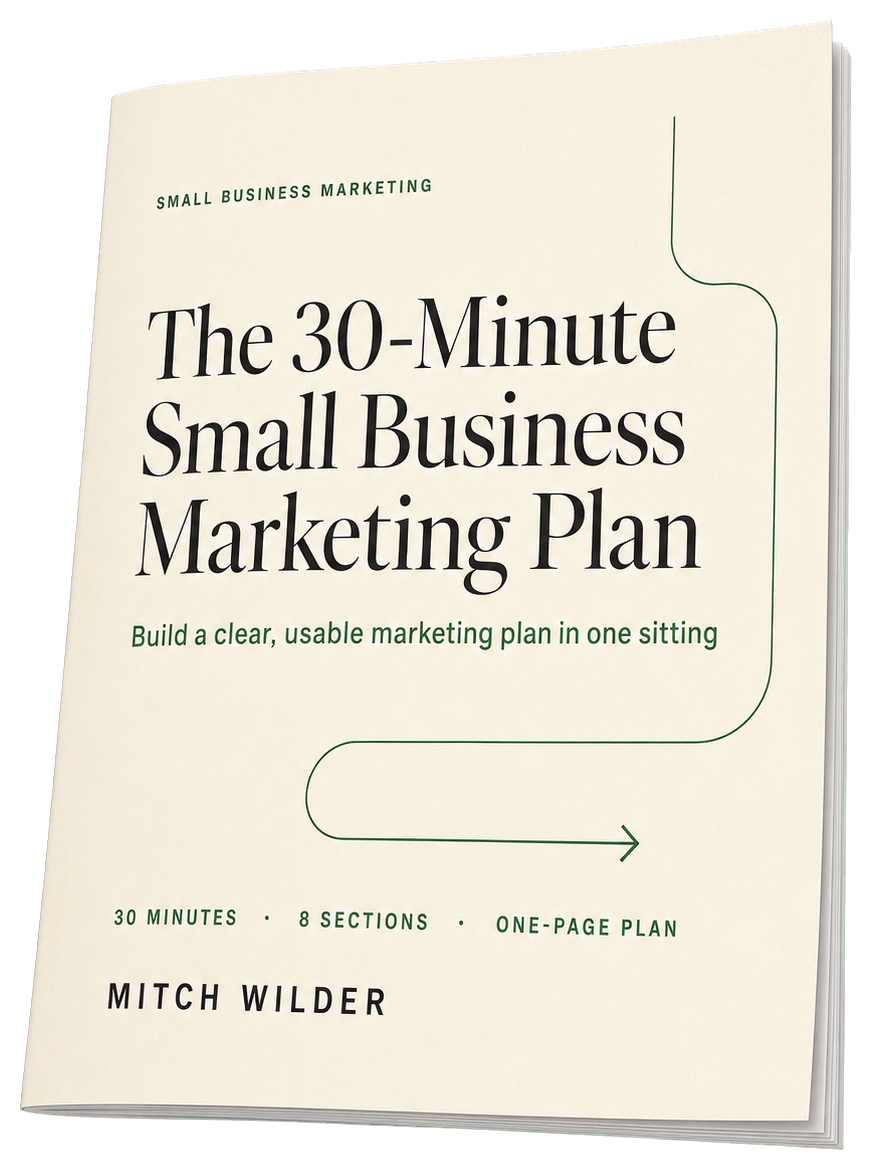
Free checklist
The 30-Minute Small Business Marketing Plan Checklist
Build a usable one-page marketing plan in about 30 minutes. Eight short sections walk you from a clear goal to a 90-day action plan, with fill-in formulas along the way.
Get the checklistWhy Leadership Teams Get Misaligned
Most teams do not become misaligned because they are careless. They become misaligned because each leader is viewing the business from a different seat.
The CEO wants predictable growth. The sales leader wants better-fit leads. Marketing wants strategic room to operate. Finance wants cleaner ROI. Operations wants fulfillment to stay realistic. Customer success wants better customers and less churn.
One of the things that I noticed is that companies often confuse marketing activity with marketing strategy. Posting on social media, running ads, sending emails, publishing blogs, and attending events are all activities. They are not the strategy itself.
Another problem is that nobody agrees on the real bottleneck. You may think you need more leads, but the real issue could be lead quality, conversion rate, offer clarity, positioning, or sales follow-up. When that is unclear, marketing becomes the dumping ground for every business problem.
This is more common than most executives admit. In a 2024 survey of 403 CMOs, Gartner found that 84% of CMOs report high levels of strategic dysfunction — the confusion and conflict that come from unclear, too numerous, or conflicting objectives marketing must support (Gartner). The same research found organizations with high dysfunction are 36% less likely to report strong business and marketing performance, and that 94% of CMOs struggle to translate enterprise strategy into actionable marketing plans.
The Cost of Misaligned Marketing Goals
Misalignment is expensive. Not just emotionally, but operationally and financially.
Here is what it usually creates:
- Wasted marketing budget on channels without a clear strategy
- Slower decision-making because every campaign becomes a debate
- Sales and marketing friction over lead quality and follow-up
- Inconsistent messaging across the company
- Poor marketing ROI tracking because nobody agreed on what success meant
If you are spending money but still asking, “What is actually working?” that is usually a leadership clarity problem first — and it shows up as marketing plan mistakes that waste time and money long before it shows up in the numbers.
Start With Business Goals, Not Marketing Goals
Marketing goals should not be created in isolation. They should be derived from business goals. That is the foundation of team alignment.
Use this formula:
Business Goal → Growth Lever → Marketing Goal → KPI → Owner → Review Cadence
Here is a simple example:
- Business goal: Increase revenue by 25% this year
- Growth lever: Generate more qualified sales opportunities
- Marketing goal: Produce 80 qualified leads per month
- KPIs: Cost per qualified lead, lead-to-call rate, call-to-close rate
- Owner: Marketing leader and sales leader
- Review cadence: Weekly scorecard, monthly strategy review
Before leadership approves any campaign, answer these questions:
- What is the most important business goal this quarter?
- What is the biggest bottleneck to growth right now?
- What role should marketing play in solving it?
- What would make us say this plan worked?
If you cannot answer those questions, you are not ready to spend money yet.
The Leadership Marketing Alignment Framework
I think the easiest way to align leadership marketing goals is to use one shared framework. Keep it on one page. If it takes a deck and three meetings to understand, your team will not use it consistently.
1. Business goal
What is the company trying to achieve? Examples: add $500K in annual revenue, increase recurring revenue, improve retention, or launch a new offer.
2. Growth constraint
What is the main thing slowing growth? Examples: not enough leads, poor lead quality, low conversion, weak positioning, or an unclear offer.
3. Target customer
Who are you trying to reach? Define the industry, company size, role or title, pain points, buying triggers, objections, and desired outcomes. Do not let the team say, “Anyone who can buy from us.” That is not a target market. That is fear disguised as strategy.
4. Core offer
What exactly are you asking the market to do? Examples: book a consultation, request a demo, start a trial, buy a service, or download a lead magnet.
5. Core message
What is the promise? Your message should answer what problem you solve, who you solve it for, what result you help them achieve, why they should trust you, and why now.
6. Primary channels
Choose the few channels most likely to reach the right customer — SEO, paid ads, email, LinkedIn, YouTube, partnerships, or referrals. Do not confuse being everywhere with being strategic.
7. KPIs
Track the numbers that show business movement, not just attention: qualified leads, booked calls, pipeline value, conversion rate, customer acquisition cost, marketing ROI, revenue influenced, and retention rate.
8. Ownership
A goal without an owner is just a wish. Leadership owns direction, marketing owns demand creation, sales owns conversion, finance owns budget reality, and operations owns delivery capacity.
9. Review rhythm
Alignment is not a one-time meeting. It is an operating habit. Review tactically every week, review strategy every month, and reset priorities every quarter.
Translate Business Goals Into Marketing Goals
A lot of teams struggle because they jump from “we want growth” to “let’s run campaigns.” That middle step matters. Here is a practical way to map it:
| Business goal | Marketing goal | Supporting KPI |
|---|---|---|
| Grow revenue | Generate more qualified opportunities | Qualified leads, booked calls, pipeline value |
| Improve profitability | Lower acquisition cost | CAC, cost per lead, conversion rate |
| Launch a new offer | Build awareness and demand | Landing page visits, demos, signups |
| Enter a new market | Reach a new audience segment | New segment leads, channel performance |
| Improve retention | Educate and nurture customers | Churn rate, repeat purchase rate |
My point is this: leadership should never approve a marketing goal unless it clearly supports a business goal.
Align Sales and Marketing Around the Same Revenue Process
Marketing creates demand. Sales converts demand. If those teams are measured differently, friction is guaranteed.
Start by defining the customer journey:
- Visitor
- Lead
- Qualified lead
- Booked call
- Sales opportunity
- Proposal
- Customer
Then agree on what a qualified lead actually means. That usually includes company size, budget, need, timing, authority, fit, and disqualifiers.
Next, create a sales follow-up agreement that covers how quickly sales responds, how many follow-up attempts are required, how lead quality is documented, how marketing gets feedback, and how often both teams review results together.
If sales says leads are bad and marketing says sales is not following up, you do not have a people problem. You have a system problem.
Choose KPIs Leadership Actually Understands
Leadership does not need a dashboard with 42 metrics. Leadership needs a scorecard that supports decisions.
Vanity metrics like impressions, likes, reach, and raw traffic can be useful, but they should not drive the conversation on their own. A better marketing scorecard includes:
- Revenue goal
- Pipeline goal
- Qualified leads
- Booked calls
- Conversion rate
- Customer acquisition cost
- Marketing spend
- ROI
- Top-performing channel
- Biggest bottleneck
- Next action
The takeaway is simple: track enough data to make smart decisions, but not so much that nobody knows what matters. If ROI keeps sparking debate, agree as a team on how to measure marketing ROI before the next campaign so everyone is scoring the game the same way.
Common Mistakes to Avoid
Here are the biggest mistakes I see when teams try to improve leadership alignment:
- Starting with tactics instead of strategy
- Letting every executive define success differently
- Tracking too many metrics
- Ignoring sales feedback
- Changing strategy too quickly
- Confusing internal opinions with market feedback
- Failing to assign clear owners
If you cannot define success before the campaign starts, you will argue about success after the campaign ends.
A Simple 90-Day Plan
If your team feels scattered, do not try to fix everything at once. Use a 90-day plan.
Days 1–15: Diagnose
Review current marketing activity, pipeline and conversion data, and spend by channel. Identify active campaigns, talk to leadership, sales, and marketing, and find the biggest growth constraint.
Days 16–30: Build the plan
Define the business goal, choose the target customer, clarify the offer, align on the message, choose channels, set KPIs, assign owners, set the budget, and establish the review cadence.
Days 31–60: Execute
Launch one priority campaign, track performance weekly, gather sales feedback, fix handoff issues, and adjust messaging if needed.
Days 61–90: Optimize
Review campaign data, identify the bottleneck, improve the offer, message, channel, or follow-up, and decide what to stop, continue, or scale. Then set the next 90-day priorities.
Leadership Marketing Alignment Checklist
Before launching your next initiative, make sure leadership agrees on:
- The business goal
- The primary growth constraint
- The target customer
- The offer
- The core message
- The main channel
- The budget
- The expected timeline
- The KPIs
- The sales handoff process
- The owner of each task
- The review cadence
- The definition of success
- The rules for scaling, pausing, or changing the campaign
That checklist alone will save a lot of wasted meetings and wasted spend.
Frequently Asked Questions About Aligning Leadership With Marketing Goals
What does it mean to align leadership with marketing goals?
It means making sure the leadership team agrees on what marketing is supposed to accomplish, how success will be measured, who owns each part of the plan, and how marketing supports the company’s larger business goals.
Why is leadership alignment important in marketing?
Because marketing touches sales, revenue, budget, operations, and customer experience. When leaders are misaligned, marketing becomes reactive, scattered, and difficult to measure.
How do you align leadership marketing goals with business goals?
Start with the main business objective, identify the primary growth constraint, choose the marketing goal that supports it, set KPIs, assign owners, and review progress consistently.
How do you get sales and marketing on the same page?
Define the target customer, agree on what counts as a qualified lead, map the customer journey, create a handoff process, track shared KPIs, and review lead quality together.
What marketing KPIs should leadership track?
Leadership should focus on qualified leads, booked calls, pipeline value, conversion rate, customer acquisition cost, marketing ROI, retention, and revenue generated.
How often should leadership review marketing goals?
I recommend weekly tactical reviews, monthly strategy reviews, and quarterly resets.
Related Reading
- How to create a small business marketing plan — the one-page system your aligned leadership team executes against.
- How to measure marketing ROI — the shared scoreboard that keeps leadership honest about what is working.
- 10 marketing plan mistakes that waste time and money — the planning errors that misalignment quietly creates.