How to Improve Your Sales Process: 9 Practical Steps

Mitch Wilder
Entrepreneur & Systems Thinker

If your team is busy all day but revenue still feels inconsistent, I think the issue is usually not effort. It’s process.
A messy sales process creates slow follow-up, weak qualification, inconsistent proposals, and deals that stall for reasons nobody can explain. The way that I look at it, if you want to improve sales process efficiency, you need a system that is clear, measurable, and repeatable.
Quick answer
To improve your sales process, map your current pipeline, define each stage clearly, qualify leads earlier, standardize follow-up, remove manual bottlenecks, use a CRM consistently, automate repetitive tasks, and review key metrics every week. The nine steps below walk through each part.
Speed is part of that system. Harvard Business Review found that firms that respond to a new lead within an hour are nearly seven times more likely to qualify that lead (Harvard Business Review) than those that wait even 60 minutes longer. A tighter process protects that window.
Key Takeaways
- Sales process efficiency is about reducing wasted time and friction, not rushing prospects.
- A good sales process helps qualified leads move forward with clear next steps.
- Most sales problems come from poor qualification, slow follow-up, unclear stages, and weak CRM habits.
- You cannot improve what you have not mapped.
- Do not automate chaos. Fix the process first, then automate it.
- Every deal needs an owner, a stage, and a next step.
- The goal is not more activity. The goal is more qualified movement through the pipeline.
How Do You Improve Your Sales Process?
To improve your sales process, map your current pipeline, define each stage clearly, qualify leads earlier, standardize follow-up, remove manual bottlenecks, use a CRM consistently, automate repetitive tasks, and review key metrics every week.
Here are the 9 practical steps:
- Map your current sales process
- Clarify your ideal customer
- Standardize pipeline stages
- Improve lead response time
- Tighten your discovery calls
- Remove bottlenecks
- Standardize follow-up
- Use your CRM like an operating system
- Measure and review the right metrics
A strong sales process is one of the biggest levers you have when you are trying to scale a small business without adding chaos, because it lets more revenue flow through the same team.
Free checklist
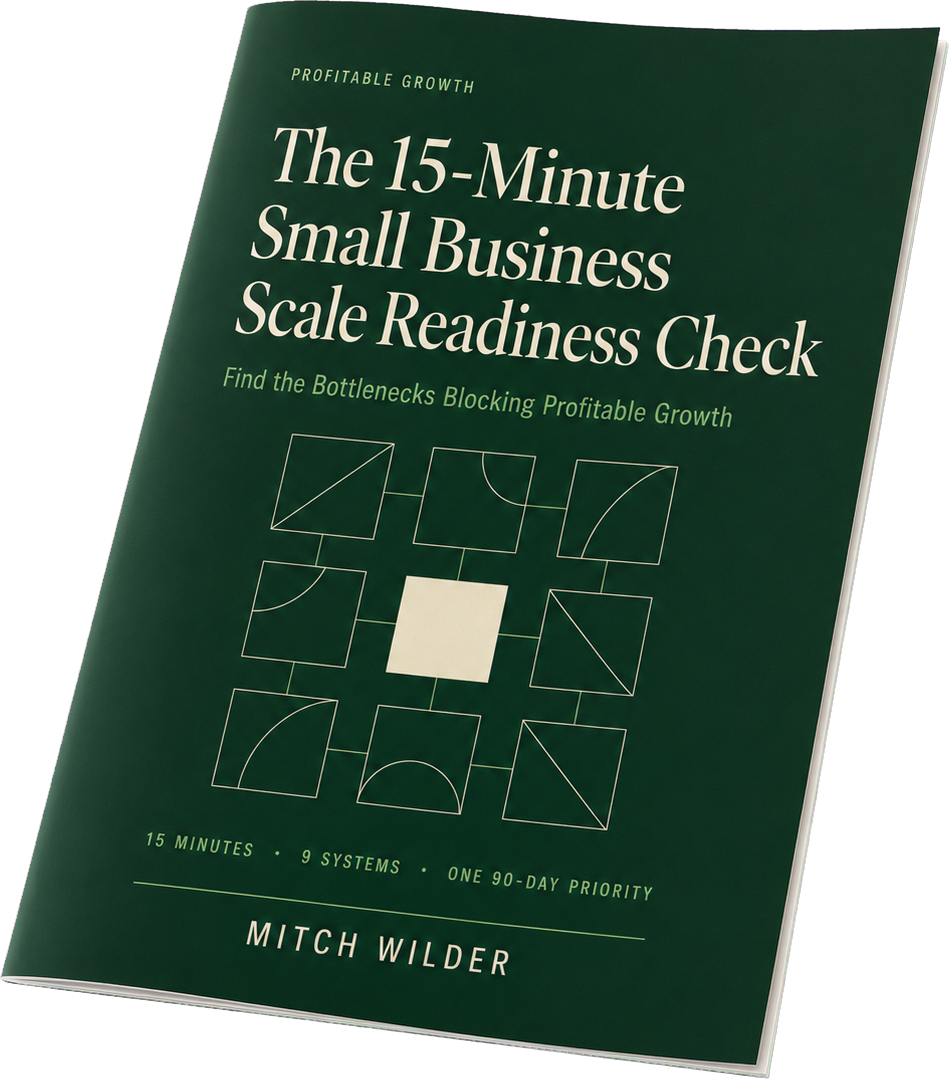
The 15-Minute Small Business Scale Readiness Check
A 45-item checklist across 9 sections that tells you whether your business is ready to scale, where your bottlenecks are, and what to fix in the next 90 days.
Get the checklistWhat Does It Mean to Improve Sales Process Efficiency?
Sales process efficiency means converting qualified leads into customers with less wasted time, less admin work, and fewer unnecessary steps. Plain and simple, it means your team spends more time selling and less time cleaning up confusion.
Efficiency is not the same as effectiveness. You need both.
| Concept | Meaning | Example |
|---|---|---|
| Sales efficiency | How smoothly and quickly the process runs | Cutting proposal turnaround from 5 days to 1 day |
| Sales effectiveness | How well the process converts | Raising close rate from 18% to 30% |
If you are efficient but targeting the wrong leads, you just move bad deals faster. If you are effective but disorganized, you still waste time and money getting results.
What Are the Signs Your Sales Process Is Broken?
Your sales process is inefficient if leads fall through the cracks, follow-up depends on memory, pipeline stages are unclear, or nobody can say exactly why deals are being lost.
Here are the warning signs I see most often:
- Leads sit too long before first response
- Sales reps use the CRM inconsistently
- Proposals get sent before real qualification happens
- Deals stay open with no next step
- Sales and marketing disagree on lead quality
- The owner has to jump into too many deals
- Lost reasons are not tracked
- Revenue feels unpredictable month to month
If your sales process is unclear, every lead becomes a custom project. That is exhausting, expensive, and impossible to scale.
The CLEAR Framework to Improve Sales Process
I like simple frameworks because teams actually remember them. The CLEAR framework gives you a clean way to improve sales process efficiency without overcomplicating the business.
- C — Clarify your ideal customer and stages
- L — Locate bottlenecks and stalled deals
- E — Eliminate unnecessary steps and admin work
- A — Automate follow-up, scheduling, and reminders
- R — Review performance every week
| Step | Focus | Goal |
|---|---|---|
| Clarify | Customer, offer, stages | Make the process easy to understand |
| Locate | Bottlenecks | Find where revenue is leaking |
| Eliminate | Friction | Remove wasted effort |
| Automate | Repetitive tasks | Save time and improve consistency |
| Review | Metrics | Improve continuously |
Step 1: Map Your Current Sales Process
Before you fix anything, document what actually happens today. Not the ideal version. The real version.
Start by answering these questions:
- Where do leads come from?
- Who responds first?
- How fast do they respond?
- How are leads qualified?
- When is a discovery call booked?
- When is a proposal sent?
- How is follow-up handled?
- Where do deals usually stall?
- What happens after the deal closes?
A simple process map should include the stage, owner, entry criteria, exit criteria, and KPI.
| Sales Stage | Owner | Entry Criteria | Exit Criteria | KPI |
|---|---|---|---|---|
| New lead | Marketing/Sales | Inquiry received | Lead contacted | Response time |
| Qualified lead | Sales | Basic fit confirmed | Discovery booked | Qualification rate |
| Discovery | Sales | Call completed | Need and fit confirmed | Discovery-to-proposal rate |
| Proposal | Sales | Proposal sent | Decision received | Proposal close rate |
| Closed won/lost | Sales | Prospect decides | Outcome recorded | Win rate/lost reason |
My point is this: you cannot improve what you have not mapped.
Step 2: Clarify Your Ideal Customer Before You Sell
A narrow focus is best. Stop chasing customers who were never likely to buy, succeed, or stay.
Your ideal customer profile should define:
- Industry
- Company size
- Budget range
- Core pain points
- Urgency
- Buying triggers
- Decision-maker access
- Deal-breakers
Then build simple qualification rules. Not every lead deserves a call.
A lead should be qualified based on:
- Clear problem
- Urgency
- Budget
- Decision authority
- Timeline
- Fit with your offer
You can also use a light scoring model:
| Score Type | What It Measures | Example |
|---|---|---|
| Fit | Are they the right type of customer? | Industry, size, budget |
| Intent | Are they actively looking? | Demo request, booked call |
| Engagement | Are they paying attention? | Email clicks, repeat visits |
| Urgency | Do they need help soon? | Deadline, active pain |
Marketing and sales are closely intertwined. If marketing is attracting the wrong people, sales will feel inefficient no matter how hard the team works. That’s why it helps to strengthen your broader customer acquisition strategies.
Step 3: Standardize Your Sales Pipeline Stages
Standardized stages make your pipeline trustworthy. Without that, forecasting is basically storytelling.
Each stage needs clear entry and exit criteria. For example, a deal should not move to “proposal sent” just because someone asked for pricing. It should move there only after the prospect is qualified and the business problem is understood.
Here is a simple pipeline for most small businesses:
| Stage | Purpose | Exit Criteria |
|---|---|---|
| New lead | Capture inquiry | Lead contacted |
| Contacted | Start conversation | Qualification started |
| Qualified | Confirm fit | Discovery booked |
| Discovery completed | Understand need | Solution fit confirmed |
| Proposal sent | Present offer | Follow-up scheduled |
| Negotiation | Resolve objections | Decision date set |
| Closed won | Deal signed | Onboarding started |
| Closed lost | Deal lost | Reason recorded |
Every deal needs an owner, a stage, and a next step. Right?
If you want deeper structure here, it’s worth reviewing your approach to building a strong sales pipeline.
Step 4: Improve Lead Response Time
Fast response improves sales pipeline efficiency because interest is highest right after the inquiry. Slow response gives competitors time to win attention.
Here are practical ways to shorten response time:
- Send instant confirmation emails
- Trigger lead alerts to the assigned rep
- Route leads by geography or service type
- Add booking links to thank-you pages
- Use saved replies for common inquiries
- Set a service-level agreement for follow-up
A useful SLA looks like this:
| Lead Type | Recommended Follow-Up |
|---|---|
| Demo request | Within 5 to 15 minutes during business hours |
| Contact form | Same business day |
| Referral | Same day, personalized |
| Pricing inquiry | Immediate automated reply plus manual follow-up |
| Content download | Automated nurture, then manual follow-up if qualified |
Speed should not replace quality. The goal is fast, relevant, helpful response.
Step 5: Improve Your Discovery Call Process
Discovery calls should qualify the opportunity, uncover the real problem, and confirm fit before you send a proposal.
One of the things that I noticed is that many teams pitch too early. That creates bloated pipelines full of weak proposals.
If you want someone to buy, stop selling.
Ask better questions instead:
Problem Questions
- What prompted you to look now?
- What is not working today?
- How long has this been an issue?
Impact Questions
- What is this costing you in time or revenue?
- What happens if nothing changes in 6 months?
- How is this affecting your team or customers?
Decision Questions
- Who is involved in the decision?
- What criteria matter most?
- What timeline are you working with?
Only send a proposal when the problem is clear, the value of solving it is understood, and the decision process is known.
Step 6: Remove Bottlenecks From the Sales Process
Sales bottlenecks are where momentum dies. If you want to optimize sales process performance, this is where the easiest wins usually live.
| Bottleneck | What It Looks Like | Fix |
|---|---|---|
| Slow response | Leads wait too long | Alerts and routing |
| Poor qualification | Bad-fit calls | Better intake questions |
| Scheduling friction | Email back-and-forth | Booking links |
| Proposal delays | Custom quotes take days | Proposal templates |
| Inconsistent follow-up | Deals go silent | Automated tasks and sequences |
| Unclear next steps | Calls end vaguely | Schedule next action live |
| Manual data entry | CRM gets ignored | Simplify fields and automate capture |
Do not fix everything at once. Prioritize the bottleneck that affects the most deals or creates the biggest revenue drag. Clearing that one constraint is often the quickest way to grow business revenue fast without spending more on marketing.
And again: do not automate chaos.
Step 7: Standardize Follow-Up Without Sounding Robotic
A strong sales follow-up process makes sure good opportunities do not disappear because someone got busy.
A basic cadence can look like this:
| Timing | Action |
|---|---|
| Immediately after call | Send summary and next step |
| Day 1 | Send helpful resource or case study |
| Day 3 | Follow up on decision criteria |
| Day 7 | Address likely objection |
| Day 14 | Check whether the priority changed |
| Day 30 | Move to nurture if no response |
Good follow-up messages include:
- The problem discussed
- The outcome the prospect wants
- A relevant proof point
- A clear next step
- A low-friction CTA
This same discipline also helps you increase customer retention, because consistent communication matters before and after the sale. It pays off, too: Harvard Business Review notes that acquiring a new customer is anywhere from 5 to 25 times more expensive than keeping an existing one (Harvard Business Review).
Step 8: Use Your CRM as a Sales Operating System
Your CRM should run the sales workflow, not just store contacts.
At minimum, track:
- Lead source
- Owner
- Pipeline stage
- Deal value
- Next step
- Next follow-up date
- Qualification status
- Lost reason
- Close date
You also need simple CRM rules:
- Every deal must have a next step
- Every deal must have an owner
- Every closed-lost deal must have a reason
- No deal should sit untouched too long
- Stages must reflect reality, not hope
If your CRM feels messy, I would start by simplifying fields before buying more software. Then, if needed, compare the best CRM tools for small businesses.
Step 9: Measure the Sales Metrics That Actually Matter
The best way to improve sales process performance is to measure movement through the pipeline. Not vanity activity. Not random dashboards. Real movement.
Here are the metrics that matter:
| Metric | What It Measures | Why It Matters |
|---|---|---|
| Lead response time | Speed to first contact | Protects warm demand |
| Lead-to-qualified rate | Lead quality | Shows whether targeting is right |
| Discovery-to-proposal rate | Discovery effectiveness | Shows how well calls are run |
| Proposal close rate | Offer strength | Shows proposal quality |
| Sales cycle length | Time to close | Reveals process speed |
| Win rate | Deal conversion | Measures effectiveness |
| Lost reason | Why deals fail | Tells you what to fix |
| Sales velocity | Revenue speed | Measures pipeline efficiency |
Sales velocity = Number of opportunities × Average deal size × Win rate ÷ Sales cycle length
If you only track five things, track these:
- Lead response time
- Qualified lead rate
- Sales cycle length
- Win rate
- Lost reason
That also makes it much easier to measure marketing ROI because you can connect lead source to revenue outcome.
Create a Weekly Sales Review Rhythm
A weekly review is where sales process improvement becomes real. Otherwise, everybody talks about fixing the pipeline and nothing changes.
Use a 30-minute agenda:
- Review new leads and response time
- Check deals with no next step
- Review stuck deals
- Identify the top bottleneck
- Review wins and losses
- Assign one process improvement
- Confirm next week’s priorities
The takeaway is simple: small weekly corrections beat big quarterly overhauls.
30/60/90-Day Sales Process Improvement Plan
If you are wondering what to fix first, here is a practical roadmap.
| Timeline | Focus | Actions |
|---|---|---|
| Days 1–30 | Diagnose | Map process, audit CRM, identify bottlenecks |
| Days 31–60 | Standardize | Define stages, create templates, set rules |
| Days 61–90 | Optimize | Track KPIs, refine follow-up, improve weak stages |
This keeps the team from getting overwhelmed. It also helps the business grow revenue through better process rather than more chaos.
Common Sales Process Mistakes to Avoid
The biggest mistakes are predictable:
- Automating before simplifying
- Treating every lead equally
- Sending proposals too early
- Using too many pipeline stages
- Tracking too many metrics
- Failing to record lost reasons
- Keeping the owner inside every deal
The way that I look at it, activity is not progress. More calls, more emails, and more meetings do not matter if qualified deals are not moving forward.
Example: A Small Business Sales Process Fix
Imagine a B2B service business getting 80 leads per month. Revenue is inconsistent. Leads are contacted after 24 to 48 hours, proposals take several days, follow-up depends on memory, and no one tracks why deals are lost.
Now the business makes a few changes:
- Instant lead notifications
- A 5-question qualification form
- Standardized pipeline stages
- A discovery call script
- Proposal templates
- Automated follow-up reminders
- Weekly stuck-deal reviews
Within 90 days, that business should have a clearer pipeline, faster response, better qualification, and stronger visibility into what is actually driving revenue.
That is what sales process improvement looks like in the real world. Not magic. Better systems.
Frequently Asked Questions About Improving Your Sales Process
How do you improve a sales process?
Map each stage from lead capture to close, define clear stages, qualify leads earlier, standardize follow-up, remove bottlenecks, use a CRM consistently, automate repetitive tasks, and review metrics weekly.
What makes a sales process efficient?
An efficient sales process moves qualified leads through the pipeline with minimal delay, clear next steps, consistent follow-up, and reliable tracking. It reduces wasted time and makes revenue more predictable.
How do you measure sales process efficiency?
Track lead response time, qualified lead rate, stage conversion rate, sales cycle length, win rate, follow-up completion, lost reasons, and sales velocity.
What is the #1 rule of sales?
Understand the customer’s problem before presenting your solution. Diagnose first, then recommend.
What are the 3 C’s in sales?
For process improvement, I think the most useful 3 C’s are Clarity, Consistency, and Conversion.
How can a CRM improve the sales process?
A CRM improves the sales process by centralizing lead data, tracking stages, assigning follow-up, logging communication history, and showing which activities actually produce revenue.
Final Takeaway: Build a Sales System, Not a Sales Scramble
If you want to improve sales process performance, stop chasing leads and start managing a system.
Map the process. Clarify who you serve. Standardize your stages. Improve speed to lead. Tighten discovery. Fix bottlenecks. Systemize follow-up. Use your CRM properly. Review the numbers every week.
That’s how you improve sales process efficiency without turning the business into a bloated machine.