Successful Marketing Frameworks: A 60-Minute Sprint

Mitch Wilder
Entrepreneur & Systems Thinker
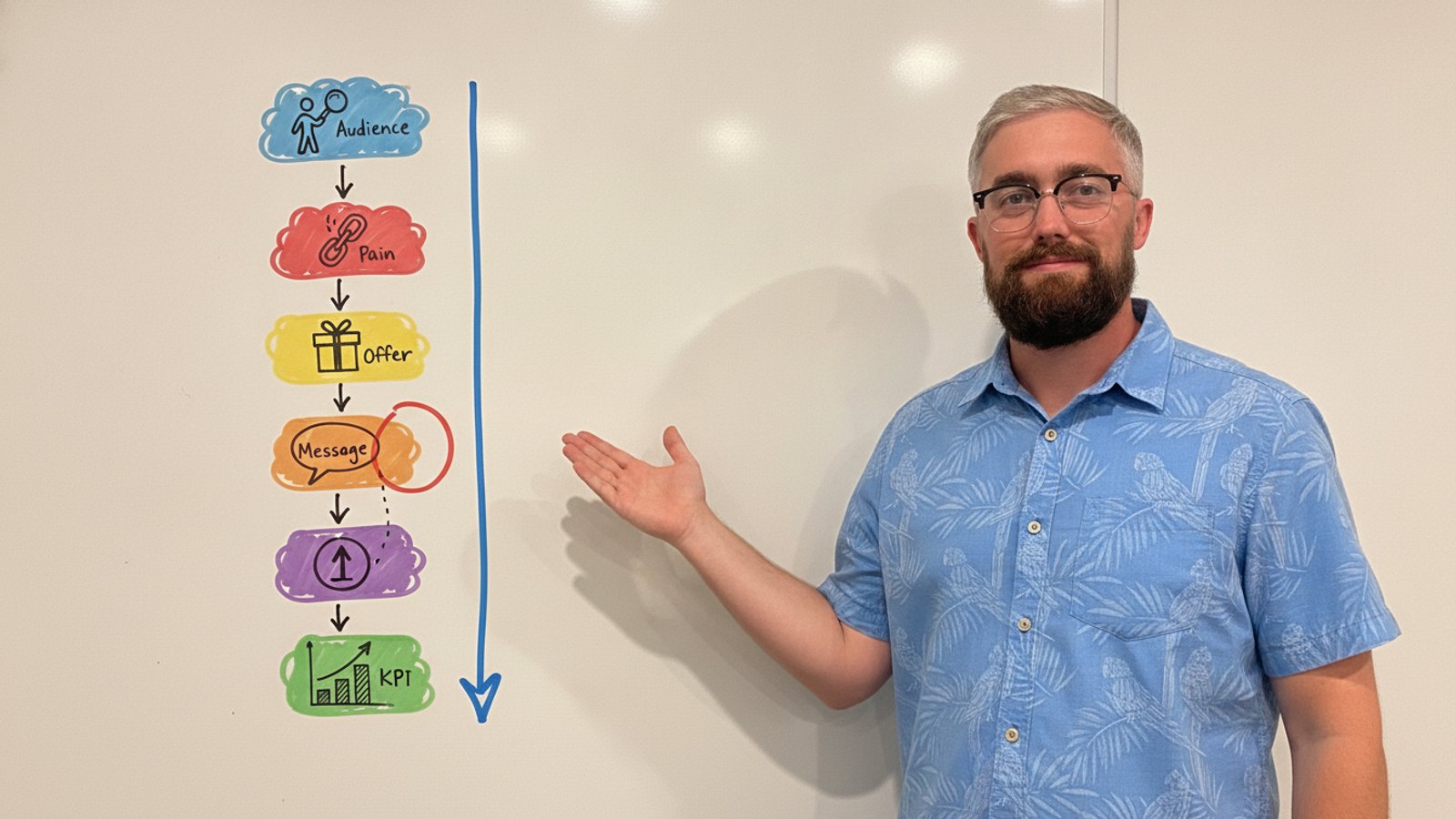
If your marketing feels like a pile of disconnected tactics, you do not need more activity. You need a better system.
I think this is where a lot of businesses get stuck. They run ads, post content, test email, tweak the website, and still do not get consistent leads. My point is this: successful marketing frameworks help you stop guessing, find the real bottleneck, and make smarter decisions fast.
Quick answer
Successful marketing frameworks are decision-making models that help you clarify your audience, offer, message, channel, and metrics. Pick the framework that matches your biggest bottleneck, then apply it in a focused 60-minute sprint instead of running more random tactics.
Key Takeaways
- Successful marketing frameworks are decision-making models for audience, offer, message, channel, and metrics.
- The best framework depends on the problem you are solving, not the tactic you want to try.
- If lead quality is weak, start with STP. If your messaging is unclear, use JTBD, AIDA, or PAS.
- If your offer feels generic, use the Value Proposition Canvas.
- If you are spread too thin, prioritize one channel instead of doing everything.
- You can apply the most useful frameworks in a focused 60-minute sprint.
What are successful marketing frameworks?
Successful marketing frameworks are structured models businesses use to make better marketing decisions, clarify their audience, position their offer, choose channels, generate leads, and measure performance.
In other words, a framework is not the marketing itself. It is the system that helps you decide what marketing to do, why you are doing it, and how you will know if it worked. Choosing the right one is a core skill inside any set of proven marketing frameworks that turn scattered effort into a repeatable system.
Why frameworks beat random tactics
Random tactics create random results.
The way that I look at it, most businesses do not have a traffic problem first. They have a clarity problem. They are unclear on who they serve, what pain they solve, what message will convert, and which channel deserves attention right now.
This is not a small issue. In a 2024 survey of 403 CMOs, Gartner found that 84% of CMOs report high levels of strategic dysfunction, the confusion and conflict that come from unclear or conflicting objectives (Gartner). A framework is one of the cheapest ways to cut through that confusion.
A good framework helps you answer five questions:
- Who are we trying to reach?
- What problem do they urgently want solved?
- Why should they choose us?
- Where should we reach them?
- What metric tells us this is working?
When you can answer those clearly, your ads improve, your content sharpens, and your funnel starts behaving like a system instead of a guessing game.
Which marketing framework should you use first?
Use the framework that matches the bottleneck.
Here is the simple rule: diagnose before you deploy. If you choose tactics before you identify the problem, you are gambling with budget and time.
| If your problem is... | Start with... | Why it helps |
|---|---|---|
| You attract the wrong leads | STP | Clarifies segments, audience, and positioning |
| Your message sounds generic | JTBD | Reveals the real progress customers want |
| Your offer feels weak | Value Proposition Canvas | Aligns offer to pains and gains |
| Your copy gets attention but not action | AIDA or PAS | Improves conversion flow |
| You are wasting effort across channels | Bullseye thinking | Forces focus on one testable channel |
| You do not know what to measure | KPI scorecard | Connects activity to outcomes |
The 60-minute sprint
You do not need a week-long offsite to use successful marketing frameworks well. You need one focused hour. This sprint is designed to help you identify the real issue, tighten the fundamentals, and leave with one practical next move.
Minute 0-10: Identify your biggest marketing bottleneck
Review your current numbers and name the one problem hurting growth the most. If you misdiagnose the bottleneck, every framework after this becomes less useful. A weak offer and a weak channel strategy can look similar from the outside, but they require different fixes.
Run through this checklist and ask where the biggest leak is:
- Lead volume
- Lead quality
- Conversion rate
- Sales call close rate
- Cost per lead
- Follow-up speed
Example: if traffic is healthy but conversions are weak, the issue is probably not awareness. It is likely messaging, offer, or funnel design.
Minute 10-20: Define your most valuable audience with STP
Use the STP framework (Segment, Target, Position) to choose one audience segment worth focusing on. Broad targeting feels safe, but it usually weakens the message. Specificity improves lead quality and makes everything downstream easier.
List the customer types you serve, identify which group gets the best results and which is most profitable, choose one primary segment, and write a positioning sentence with this template:
We help [specific audience] achieve [specific outcome] without [specific pain or obstacle].
Example: We help owner-operators of small home service businesses generate more qualified leads without relying on manual follow-up.
Minute 20-30: Clarify the customer's real pain with JTBD
Use Jobs-to-Be-Done to define what progress your customer is actually trying to make. Customers do not buy because your service has features. They buy because they want a better future state.
Ask what triggered the search, the frustration they want to escape, and the outcome they want, then write the job using this formula:
When [situation], I want to [motivation], so I can [desired outcome].
Example: When my lead flow is inconsistent, I want a simple acquisition system, so I can grow without making every month feel uncertain. That is better than generic messaging like "full-service marketing solutions." One sounds like the customer. The other sounds like the business talking to itself.
Minute 30-40: Strengthen your offer with the Value Proposition Canvas
Rewrite your offer around pain relievers and gain creators. A lot of offers are built around what the business wants to sell, not what the buyer urgently wants solved. That disconnect kills conversions.
| Customer pain | Offer fix |
|---|---|
| Wasting money on broad campaigns | Narrow targeting and channel focus |
| Leads are inconsistent | Predictable funnel and follow-up process |
| Marketing feels chaotic | One-page system with clear KPIs |
Example: instead of saying "we offer digital marketing services," say "we build predictable lead generation systems for service businesses that need more qualified inbound opportunities."
Minute 40-50: Build one conversion message with AIDA or PAS
Create one core message for your landing page, ad, email, or outreach. A strong message creates momentum. A weak message makes even a good channel underperform.
Use AIDA when you need a simple conversion flow: Attention (call out the problem), Interest (show you understand it), Desire (make the outcome tangible), Action (tell them what to do next).
Use PAS when the audience is already problem-aware: Problem (name the pain), Agitate (show the cost of leaving it unsolved), Solution (present a clear next step).
Minute 50-60: Choose one channel test and one KPI
Pick one channel to test and one metric to judge it. This is where strategy becomes execution. Without a channel decision and a metric, your sprint stays theoretical.
Example channel tests include publishing one pain-point article for organic search, running a tightly targeted paid search campaign, launching one lead magnet to an email list, or testing one LinkedIn outreach message to a niche audience. Useful KPIs include cost per lead, landing page conversion rate, booked calls, qualified lead rate, and reply rate.
Plain and simple, if you test three channels at once, you usually learn less than if you test one channel with real discipline.
The one-page framework stack that actually works
For most businesses, I recommend a simple stack of successful marketing frameworks:
- STP for audience clarity
- JTBD for customer motivation
- Value Proposition Canvas for offer design
- AIDA or PAS for messaging
- One channel test plus one KPI for execution and measurement
That is enough to create a functional marketing operating system without overcomplicating things.
A mistake I see all the time
I have watched founders waste effort on too many channels before understanding the customer and funnel. One founder runs paid ads, posts on LinkedIn, starts a blog, hires a freelancer, experiments with email, and still has no consistent pipeline. The problem is not effort. The problem is unfocused effort.
That is why I keep coming back to frameworks. If you cannot clearly answer who you serve, why they care, where to reach them, and what message gets them to act, adding more channels will not save you.
Common mistakes when using marketing frameworks
Using too many frameworks at once
Framework overload is still overload. Start with the bottleneck. One framework that solves the right problem beats six frameworks used halfway.
Treating frameworks like worksheets
A framework is only useful if it changes decisions. If you fill out a model and nothing changes in your targeting, offer, messaging, or metrics, you did an exercise. You did not improve the business.
Skipping customer research
Businesses often want better copy before they want better customer understanding. Talk to real customers. Ask what triggered the search, what alternatives they considered, what nearly stopped the purchase, and what outcome would make the solution a no-brainer.
Measuring vanity metrics
Impressions, likes, and follower count can be useful context, but they are not the scoreboard. Better metrics include qualified leads, conversion rate, cost per lead, close rate, and customer acquisition cost.
How to know if the framework sprint worked
A framework is working if it improves decision quality and business outcomes. Look for these signs:
- Your audience is more specific
- Your message feels sharper
- Your offer is easier to explain
- Your channel choice feels more deliberate
- Your KPI is connected to revenue, not just activity
In other words, you should come out of the sprint with less confusion and one clearer next move.
Frequently Asked Questions About Successful Marketing Frameworks
What are the most successful marketing frameworks?
The most useful successful marketing frameworks include STP, JTBD, the Value Proposition Canvas, AIDA, PAS, funnel frameworks, channel prioritization models, and KPI scorecards. Each one helps solve a different problem in the marketing system.
What is the best marketing framework for small businesses?
For most small businesses, I think the best starter stack is STP, JTBD, Value Proposition Canvas, and AIDA. That combination helps you define the audience, understand the pain, improve the offer, and write clearer conversion messaging.
How do I choose the right marketing framework?
Choose based on the bottleneck. If your audience is unclear, use STP. If your offer is weak, use the Value Proposition Canvas. If your message is not converting, use AIDA or PAS.
Can one marketing framework solve every problem?
No. A single framework can help you solve one kind of problem well, but marketing usually requires a stack. Audience, offer, message, channel, and measurement are different jobs.
Are marketing frameworks still useful in digital marketing?
Absolutely. They matter even more now because digital channels make it easier to create activity without creating results. Frameworks force focus, which is what most businesses actually need.
Next steps
If you only do three things after reading this, do these:
- Identify your biggest bottleneck
- Rewrite your audience and offer in one sentence
- Launch one channel test with one KPI
You do not need another random tactic. You need a clear system that tells you what to fix, what to test, and what to measure. The businesses that grow are usually the ones using successful marketing frameworks to make better decisions and move with more precision.