Strategies for Scaling a Small Business: Complete Growth Guide

Mitch Wilder
Entrepreneur & Systems Thinker

Scaling sounds exciting until your business starts breaking under the weight of more customers, more payroll, more ad spend, and more moving parts.
I think this is where a lot of small business owners get stuck. Revenue goes up, but so do stress, inefficiency, founder dependency, and wasted money. My point is this: growth is not the same as scaling.
One pattern I see consistently: the founder becomes the bottleneck long before they realize it. I shared what that looked like from the inside in the hardest business advice I've taken in 20 years — including the point where stepping back actually made the business work better.
If you want real strategies for scaling a small business, you need a system that helps you grow revenue without letting costs, chaos, and complexity grow at the same rate.
Quick answer
The best strategies for scaling a small business are to narrow your market, stabilize a profitable offer, build predictable customer acquisition, improve your sales process, increase conversion rates, document operations, automate repetitive work, improve retention, hire for bottlenecks, protect cash flow, and expand only after the core business works.
This matters because scaling is where most of the risk lives. Roughly half of small businesses fail within five years (U.S. Bureau of Labor Statistics), and many of those failures happen while the business is trying to grow faster than its systems and cash flow can handle. Scaling with a plan is how you avoid becoming that statistic.
Key Takeaways
- Scaling means increasing revenue without increasing costs and founder involvement at the same pace.
- Most small businesses should improve the core business before adding new channels, people, or products.
- Predictable customer acquisition is one of the biggest differences between random growth and scalable growth.
- If you do not know your CAC, LTV, margins, and conversion rates, you are guessing.
- Standardized offers, SOPs, and automation create leverage.
- Retention and referrals often produce more profitable growth than pure acquisition.
- Hiring should remove bottlenecks, not just make the company look bigger.
- Cash flow problems can kill a growing business even when revenue looks healthy.
- The best scaling strategy depends on your business model.
- A focused 90-day plan works better than trying to fix everything at once.
What Does It Mean to Scale a Small Business?
Scaling a small business means increasing revenue and capacity without increasing costs, complexity, or workload at the same rate. In other words, a scalable business becomes more efficient as it grows.
Here is the way that I look at it: if your revenue is increasing but your stress, payroll, ad spend, and customer complaints are increasing just as fast, you may be growing, but you are not scaling.
| Growth | Scaling |
|---|---|
| More revenue | More revenue with better efficiency |
| More customers | More profitable customers |
| More work | More leverage |
| More employees | Better systems and smarter hiring |
| More activity | More predictability |
| Founder involved in everything | Founder delegates through systems |
Free checklist
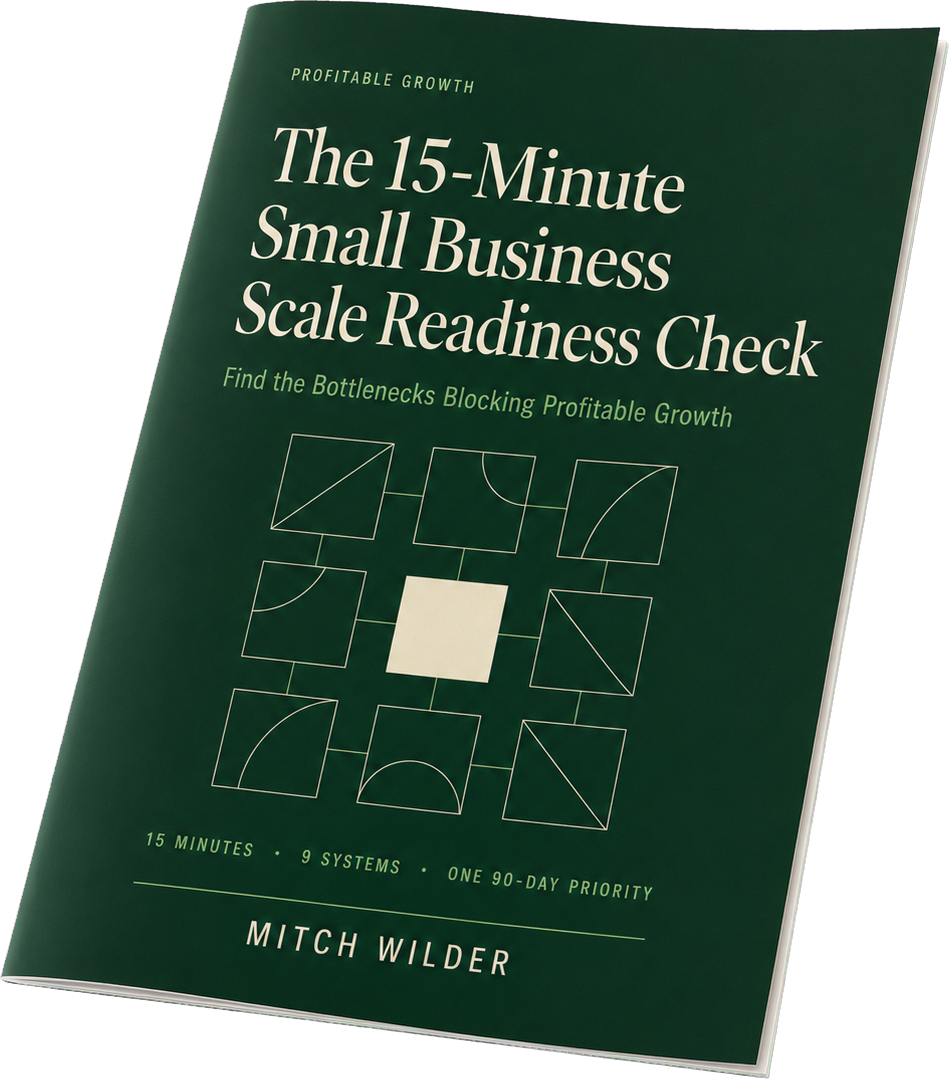
The 15-Minute Small Business Scale Readiness Check
A 45-item checklist across 9 sections that tells you whether your business is ready to scale, where your bottlenecks are, and what to fix in the next 90 days.
Get the checklistAre You Actually Ready to Scale?
A business is ready to scale when it has consistent demand, a profitable offer, reliable delivery, positive cash flow, documented processes, and a repeatable way to acquire and convert customers.
A lot of owners want to scale when what they really need is to stabilize.
Signs you are ready
- You know your ideal customer
- Your offer is proven and profitable
- Leads come in consistently
- Your sales process converts at a predictable rate
- You know your customer acquisition cost
- Customers stay, rebuy, or refer
- Your team can operate without constant approval from you
- Your margins are healthy
- Your cash position can support growth
- You can measure marketing ROI
Signs you are not ready yet
- You rely mostly on word of mouth
- You cannot clearly define your best-fit customer
- You are spending on marketing without tracking results
- Delivery depends on you personally
- Your team is already overloaded
- Cash flow is unstable
- Customers churn quickly
- Sales are inconsistent
- You keep adding tactics without a real strategy
- Leadership priorities are unclear
The Numbers You Need to Know Before Scaling
Before you hire, run ads harder, launch a new product, or expand into new markets, you need to know your numbers. Scaling without metrics is just expensive guessing.
Core metrics to track
| Metric | Why It Matters |
|---|---|
| Revenue growth rate | Shows momentum |
| Gross profit margin | Tells you if your core offer is worth scaling |
| Net profit margin | Shows real business health |
| Customer acquisition cost | Keeps marketing spend under control |
| Customer lifetime value | Shows how much a customer is worth |
| LTV:CAC ratio | Reveals marketing scalability |
| Sales conversion rate | Measures sales efficiency |
| Retention rate | Indicates customer stickiness |
| Churn rate | Shows revenue leakage |
| Revenue per employee | Measures operational leverage |
| Cash conversion cycle | Helps prevent cash crunches |
A business is easier to scale when lifetime value is significantly higher than acquisition cost, margins are healthy, and delivery does not require the founder in every step.
Plain and simple, do not scale paid ads, headcount, inventory, or locations until you know:
- What it costs to acquire a customer
- How much that customer is worth
- How long it takes to recover acquisition costs
- Which channels bring profitable customers
- Which offers produce the best margins
If measuring return is where you get stuck, work through this deeper guide on how to measure marketing ROI before you pour more money into growth.
The S.C.A.L.E. Method
I like using a simple framework here because most owners are overwhelmed, not uninformed.
The S.C.A.L.E. Method gives you the right order of operations:
- S — Stabilize your core offer, operations, and margins
- C — Create predictable customer acquisition
- A — Automate and document repeatable processes
- L — Lift lifetime value through retention and referrals
- E — Expand strategically once the core engine works
That is the sequence. Right? Not random tactics. Not shiny objects. Not “let’s do everything.”
Strategy 1: Narrow Your Target Market Before You Expand
The fastest path to growth is often more focus, not more reach.
One of the things that I noticed across small businesses is this: when you try to serve everyone, your messaging gets weaker, your sales cycle gets longer, and your margins usually get worse.
Why focus helps you scale
- Easier messaging
- Better conversion rates
- Lower acquisition costs
- Stronger referrals
- Clearer positioning
- Easier sales training
- Better delivery consistency
Use this statement:
We help [specific customer] achieve [specific outcome] without [specific frustration].
Strategy 2: Productize or Standardize Your Core Offer
If every sale requires a custom proposal, custom scope, custom timeline, and custom pricing model, scaling will be painful.
A scalable business needs repeatability.
Standardize these elements
- What is included
- What is excluded
- Pricing
- Delivery steps
- Onboarding
- Templates
- Checklists
- Success metrics
My point is this: if your team has to reinvent the wheel every time, you do not have a scalable business. You have a custom job shop.
Strategy 3: Build a Predictable Customer Acquisition System
A predictable customer acquisition system is a repeatable process for attracting, converting, and tracking profitable customers through specific channels.
Many businesses use accidental marketing. They post randomly, run ads without a funnel, and chase whatever tactic is trending. That is not a system. If this is your biggest gap, the full playbook lives in my guide to customer acquisition strategies for small business.
Build it in this order
- Define your target audience
- Create a compelling offer
- Choose one or two primary channels
- Build a landing page or conversion path
- Capture leads
- Follow up automatically
- Track source, cost, conversion, and revenue
- Improve weekly
Best channels by business type
| Business Type | Best Channels |
|---|---|
| Local service | Local SEO, reviews, referrals, paid search |
| B2B service | LinkedIn, SEO, webinars, outbound, partnerships |
| Ecommerce | Paid social, SEO, email, influencer marketing |
| Consulting | Content, referrals, webinars, LinkedIn |
| SaaS | Content, paid search, product-led growth, outbound |
If you want to scale a small business, this is one of the biggest levers. Predictable demand changes everything. For more ways to fill the top of the funnel, see these lead generation strategies for small businesses.
Strategy 4: Improve Your Sales Process Before Buying More Traffic
More leads do not fix a broken sales process. They just create more waste.
Marketing and sales are very closely intertwined. Marketing creates demand. Sales converts demand. Customer success keeps the revenue alive. Tightening this sequence is usually the fastest way to grow business revenue fast without buying more traffic.
Build a simple pipeline
- New lead
- Qualified lead
- Discovery call
- Proposal
- Follow-up
- Closed won
- Closed lost
- Onboarding
Install a CRM early. You need visibility into follow-up, conversion rates, pipeline value, and lead sources. Memory is not a sales system.
Strategy 5: Increase Conversion Rates Before Increasing Spend
Before you spend more money, improve the percentage of visitors and leads who become customers.
This is one of the highest-ROI small business growth strategies because it lets you make more from the traffic and leads you already have.
Conversion levers to optimize
- Website messaging
- Headline clarity
- Offer strength
- Calls to action
- Testimonials
- Case studies
- Pricing presentation
- Guarantee
- Lead magnet
- Booking or checkout flow
- Follow-up emails
Quick conversion audit
- Is it obvious who the offer is for?
- Is the result clear?
- Is the CTA easy to find?
- Is there proof?
- Is the offer specific?
- Is the next step frictionless?
- Is mobile experience strong?
- Is tracking installed?
Strategy 6: Increase Customer Lifetime Value
Customer lifetime value can be increased by improving onboarding, retention, upsells, cross-sells, pricing, customer experience, and referrals.
This matters because higher LTV allows you to spend more to acquire customers and still protect your margins.
Ways to lift LTV
- Better onboarding
- Customer education
- Recurring revenue offers
- Upsells
- Cross-sells
- Loyalty programs
- Premium tiers
- Maintenance plans
- Referral incentives
The takeaway is simple: the easiest customer to grow is often the one you already have. If retention is your weak spot, start with these ways to increase customer retention and loyalty.
Strategy 7: Create SOPs So the Business Does Not Depend on You
You cannot scale a small business if every decision flows through the owner.
Standard operating procedures are documented instructions for recurring tasks. They reduce inconsistency, speed up training, and make delegation real.
Document these first
- Lead intake
- Sales follow-up
- Onboarding
- Fulfillment
- Billing
- Support
- Review requests
- Reporting
- Hiring and training
A simple SOP should include:
- Process name
- Owner
- Trigger
- Tools
- Steps
- Quality standard
- Common mistakes
- Escalation rules
Strategy 8: Automate Repetitive Tasks with the Right Technology
Automation helps you scale by reducing manual work, improving follow-up, and increasing consistency.
But automation is not magic. Do not automate a broken process. Fix the workflow first, then automate it.
Best places to automate first
- Lead capture
- Email follow-up
- Appointment scheduling
- CRM updates
- Invoicing
- Onboarding
- Review requests
- Reporting
- Task handoffs
- FAQ support
Simple tech stack categories
| Need | Tool Type |
|---|---|
| Lead tracking | CRM |
| Follow-up | Email platform |
| Delivery | Project management |
| Scheduling | Calendar tool |
| Analytics | Reporting platform |
| Automation | Workflow tool |
| Finance | Accounting software |
| Dashboards | KPI tool |
Strategy 9: Hire for Bottlenecks, Not Vanity
Hiring should remove a real constraint in the business.
Too many owners hire because things feel busy. Busy is not the same as blocked. The way that I look at it, you hire when a role clearly improves revenue, delivery, customer experience, or operational leverage.
Common scaling hires
- Operations manager
- Sales rep
- Customer success manager
- Marketing manager
- Admin support
- Fulfillment specialist
- Bookkeeping or finance support
- Project manager
Ask before hiring:
- What bottleneck does this role remove?
- What outcome will they own?
- How will success be measured?
- How fast should the role pay for itself?
Strategy 10: Protect Cash Flow While Scaling
A business can be profitable on paper and still die from cash flow pressure.
Scaling often creates timing problems. You spend money before the revenue fully catches up.
A useful guardrail on the spending side: the U.S. Small Business Administration suggests allocating around 7 to 8 percent of gross revenue to marketing for most small businesses. If your growth spend is drifting well past that while cash reserves shrink, that is a signal to tighten the plan before pushing harder.
Put these controls in place
- Monthly cash flow forecast
- Budget by initiative
- Receivables process
- Emergency reserve
- Margin review
- Scenario planning
- Clear stop-loss rules for campaigns or hires
Before any major investment, ask:
- How much cash does this require?
- When should this produce a return?
- What metric proves it is working?
- What is the downside if results are delayed 90 days?
Strategy 11: Use Partnerships to Grow Faster with Less Waste
Partnerships can help you scale without building every channel from scratch.
This works especially well for service businesses, local businesses, agencies, and consultants.
Good partnership types
- Referral partnerships
- Co-marketing partnerships
- Affiliate partnerships
- Strategic alliances
- Technology partners
- Local business partnerships
A simple outreach script:
Hi [Name], I noticed we both serve similar customers who are trying to grow more predictably. I think there may be a strong referral fit between us. Would you be open to a quick conversation?
Strategy 12: Expand Only After the Core Business Works
New markets, products, channels, and locations can accelerate growth. They can also multiply chaos.
The best scaling strategy for most small businesses is to improve the core business before expanding. Strengthen the offer, margins, marketing, sales, retention, and operations first.
Expand only when
- Your offer is profitable
- Customers are satisfied
- Delivery is documented
- Team capacity exists
- Cash flow is stable
- Acquisition is measurable
- Leadership is aligned
- Success metrics are clear
Leadership alignment is easy to skip and expensive to ignore. If your leaders are not rowing in the same direction, it helps to align leadership with marketing goals before you expand. Pilot before you scale:
- One market
- One offer
- One channel
- One segment
- One budget
- One review window
Which Scaling Strategy Fits Your Business Model?
| Business Type | Best First Strategy | What to Avoid |
|---|---|---|
| Local service | Local SEO, reviews, scheduling systems | Expanding locations too early |
| B2B service | Productized offers, pipeline, referrals | Customizing every deal |
| Ecommerce | Conversion optimization, email retention | Scaling ad spend before knowing margins |
| Consulting | Productized offers, content authority | Selling only founder time |
| Agency | SOPs, niche positioning, recurring retainers | Taking every client |
| SaaS | Onboarding, retention, product-led growth | Acquiring users who churn quickly |
A 90-Day Plan for Scaling Your Small Business
A 90-day scaling plan should start with an audit, then focus on bottlenecks, systems, metrics, and one controlled growth initiative.
Days 1–15: Audit
- Review revenue by offer
- Identify best customers
- Calculate CAC and LTV
- Review channels
- Review conversion rates
- Identify operational bottlenecks
- Review cash flow and margins
Days 16–30: Choose one priority
- Improve lead generation
- Improve conversion
- Increase retention
- Document operations
- Hire for a bottleneck
- Improve cash flow
Days 31–60: Build the system
- Create SOPs
- Set up CRM stages
- Create follow-up sequences
- Improve landing pages
- Install tracking
- Train the team
- Build a dashboard
Days 61–90: Run a growth sprint
- Launch one initiative
- Track results weekly
- Improve weak points
- Monitor cash impact
- Gather team feedback
- Decide to scale, pause, or adjust
Common Scaling Mistakes to Avoid
The most common scaling mistake is adding more before fixing the core systems that make growth profitable and repeatable.
Avoid these mistakes:
- Scaling before the offer is proven
- Spending more on marketing without tracking ROI
- Expanding into too many channels
- Hiring too quickly
- Ignoring retention
- Keeping the founder as the bottleneck
- Scaling weak margins
- Failing to align the leadership team
Helpful Tools for Scaling a Small Business
Tools support scalable systems. They do not create them.
Helpful categories include:
- CRM
- Email marketing software
- Project management tools
- Analytics platforms
- Dashboard software
- Automation tools
- Scheduling software
- Accounting tools
- Customer support systems
- AI tools for SOPs, summaries, and feedback analysis
Small Business Scaling Checklist
Before you scale, make sure you have:
- A clear target customer
- A proven offer
- Healthy margins
- Predictable customer acquisition
- A documented sales process
- A CRM or tracking system
- Clear KPIs
- Strong retention
- SOPs for key workflows
- Team accountability
- Cash flow visibility
- A 90-day plan
- One focused initiative to test first
Frequently Asked Questions About Scaling a Small Business
What is the best strategy for scaling a small business?
Start by stabilizing your core offer, margins, operations, and customer acquisition. Once those are working, you can scale through automation, hiring, partnerships, and expansion.
What is the difference between growing and scaling a business?
Growth usually means revenue increases along with costs and complexity. Scaling means revenue increases faster than costs and the business becomes more efficient.
How do you scale a small business with limited money?
Focus on low-cost, high-leverage moves first: improve conversion rates, increase retention, document processes, generate referrals, build partnerships, and automate repetitive tasks before investing heavily in ads or headcount.
What metrics should I track when scaling a small business?
Track CAC, LTV, gross margin, net margin, conversion rate, retention, churn, revenue per employee, cash flow, and marketing ROI.
Should I hire before scaling?
Only if the hire removes a real bottleneck and has a clear connection to revenue, delivery, or leverage. Hiring too early creates unnecessary cash pressure.
How long does it take to scale a small business?
There is no fixed timeline, but a focused 90-day sprint is usually enough to fix one major bottleneck and prove out one repeatable system. Real scaling then compounds over several of those cycles rather than happening in a single push.
Scale With Strategy, Not Chaos
Scaling is not about doing more of everything. It is about building a business that produces better results with less chaos, clearer systems, stronger margins, and more predictable customer acquisition.
If you only do three things next, do these:
- Audit your numbers
- Choose one bottleneck
- Build one repeatable system around it
That is how you scale a small business the smart way. Not with more noise. With more leverage. Plain and simple.
If revenue growth is the immediate priority, see how to grow business revenue fast for the 15 specific levers to pull in the next 90 days.