How to Analyze Market Trends for Strategic Growth

Mitch Wilder
Entrepreneur & Systems Thinker

If your marketing feels like a series of disconnected experiments, you probably do not have a tactics problem. You have a market intelligence problem.
I think this is one of the biggest reasons businesses waste time and money. They launch campaigns, copy competitors, chase channels, and react to whatever is loudest this month. If you want to analyze market trends the right way, the goal is simple: make decisions based on evidence, not guesswork.
Quick answer
To analyze market trends, start with a clear business question, collect data from customers, competitors, search behavior, sales performance, and industry sources, then look for repeated patterns. After that, validate whether the trend is growing, relevant, durable, and profitable before turning it into a specific growth move.
This is not busywork — it is a survival skill. Roughly half of small businesses fail within five years (U.S. Bureau of Labor Statistics), and many of them lose because demand shifted while they kept doing what used to work. Reading the market early is one of the cheapest ways to stay on the right side of that statistic.
Key Takeaways
- Market trend analysis helps you spot shifts in demand, customer behavior, competition, and technology.
- The best trend analysis starts with a specific strategic question, not random research.
- A real trend shows up across multiple sources over time, not just one spike on social media.
- You should focus on the trends most connected to revenue, customer acquisition, retention, and positioning.
- I use a simple system called the Trend-to-Growth Framework to move from signal to action.
- The fastest way to avoid accidental marketing is to score trends before investing budget.
- Small businesses do not need a giant research department. They need a repeatable process.
- The outcome is not a report. The outcome is a better decision.
What Is Market Trend Analysis?
Market trend analysis is the process of identifying and interpreting shifts in customer behavior, demand, technology, competition, pricing, and economic conditions. It matters because it helps you understand where the market is moving so you can make smarter decisions about growth.
In plain English, it helps you answer questions like:
- What do customers want more of?
- What are they losing interest in?
- Which competitors are gaining traction?
- Which offers are becoming more attractive?
- Which channels are becoming more or less effective?
For example, if a local fitness studio sees rising searches for “strength training for women over 40,” stronger engagement on related content, and more competitors building offers around that angle, that is not random noise. That may be a real market opportunity.
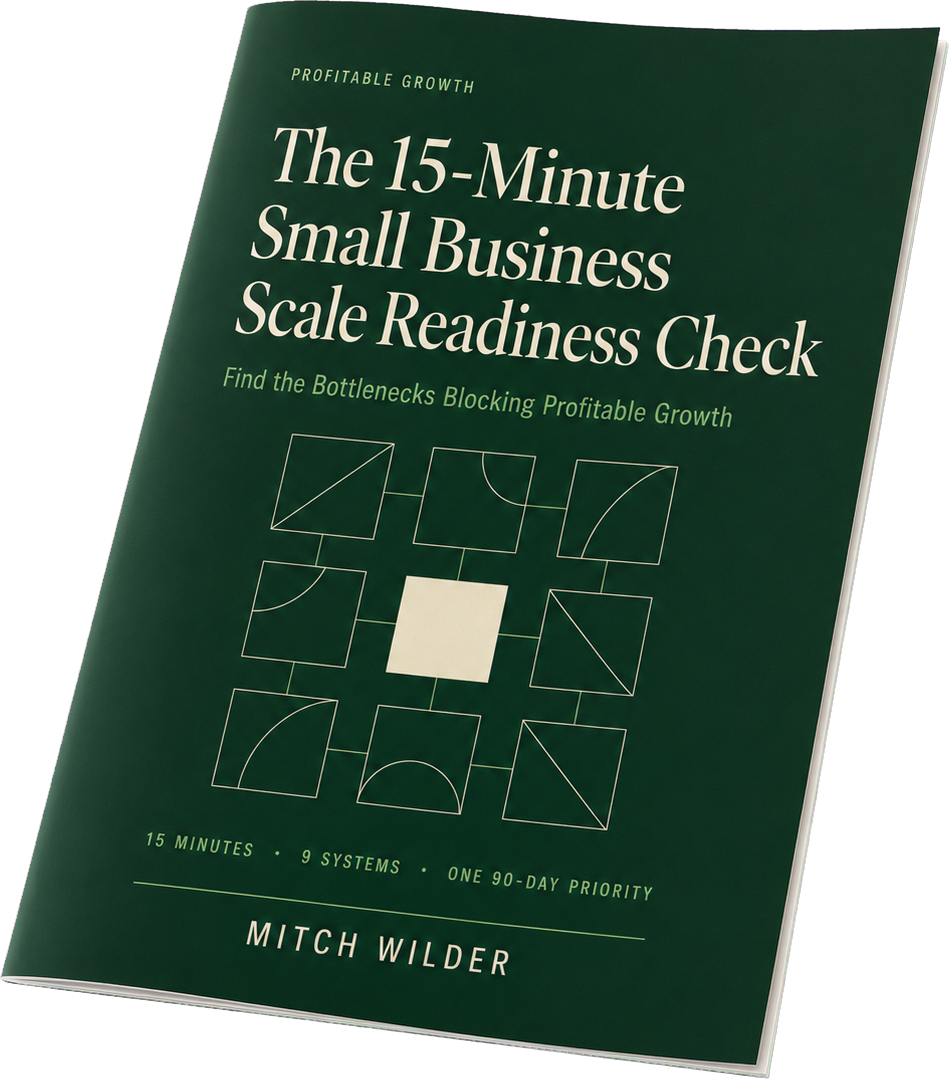
Free checklist
The 15-Minute Small Business Scale Readiness Check
A 45-item checklist across 9 sections that tells you whether your business is ready to scale, where your bottlenecks are, and what to fix in the next 90 days.
Get the checklistWhy Analyzing Market Trends Matters for Strategic Growth
The way that I look at it, trend analysis is not an academic exercise. It is a practical growth tool. It is also a core capability if you are serious about scaling a small business without betting the company on a hunch.
Stop Accidental Marketing
Accidental marketing happens when you promote without understanding where demand is going. You run ads because someone told you to. You start posting because everyone else is. You buy software and hope it fixes strategy.
That approach burns budget fast.
Find Better Growth Opportunities
When you identify market trends early, you can move before the opportunity becomes crowded. That might mean:
- targeting a new customer segment
- packaging a new service
- changing your message
- testing a new channel
- improving pricing or positioning
Improve Marketing ROI
Better market insight usually leads to better targeting, stronger messaging, and more relevant offers. In other words, you stop pushing what you want to sell and start aligning with what customers already care about. That connection to results is why it pays to also measure marketing ROI so you can prove a trend actually moved revenue.
Stay Ahead of Competitors
Competitors often react late. Businesses that win consistently tend to notice demand shifts earlier and act with more focus.
Align Leadership Around Evidence
A solid market trend review gives your team a shared view of reality. Right? That matters because strategic decisions get easier when everyone is looking at the same evidence instead of arguing from opinion — the same reason it helps to align leadership with marketing goals before you commit budget.
Market Trends vs. Fads vs. Signals
Before you act on anything, you need to separate real movement from hype.
| Concept | Meaning | Example | Strategic Value |
|---|---|---|---|
| Signal | Early clue that something may be changing | More prospects asking about AI tools | Monitor it |
| Trend | Sustained pattern across multiple sources | Rising demand for AI-powered automation | Validate and act |
| Fad | Short-lived spike in attention | Viral challenge or buzzword | Usually low value |
| Structural shift | Long-term market change | Remote work changing buying behavior | High strategic importance |
A real trend has consistency. A fad has attention. Those are not the same thing.
The 7 Types of Market Trends to Analyze
If you want to know how to identify market trends, start by knowing where to look.
1. Customer Behavior Trends
Look at changing needs, preferences, objections, and buying habits.
Examples:
- buyers want transparent pricing
- customers expect faster response times
- decision-makers prefer self-service research before talking to sales
2. Demand Trends
These show what people are actively searching for, asking for, or buying.
Good sources include:
- Google Trends
- keyword tools
- website search data
- support tickets
- sales call notes
3. Competitor Trends
Study changes in:
- offers
- pricing
- messaging
- product launches
- ad angles
- customer reviews
4. Technology Trends
This matters a lot in digital marketing and small business growth.
Examples include AI automation, CRM workflows, predictive analytics, and no-code tools.
5. Channel Trends
Attention shifts. The channels that worked two years ago may not work the same way now.
You might see:
- LinkedIn gaining importance for B2B
- short-form video influencing demand
- SEO rewarding answer-first content
- email becoming more valuable as a trust channel
6. Economic and Industry Trends
External forces shape buying behavior whether you like it or not.
Watch things like:
- inflation
- labor costs
- regulation
- supply chain issues
- industry hiring patterns
7. Cultural and Social Trends
These influence what customers value and what they trust.
Think sustainability, privacy, convenience, ethical sourcing, and local buying.
Before You Analyze Market Trends, Define the Strategic Question
This is where most people get it wrong. They gather a pile of data with no decision attached to it.
Before you open Google Trends, review competitor sites, or read industry reports, define the question.
Use this formula:
We want to understand whether [trend/opportunity] is growing among [target customer] so we can decide whether to [strategic action] within [timeframe].
Example:
We want to understand whether demand for AI-powered CRM automation is growing among small B2B service firms so we can decide whether to launch a consulting offer this quarter.
My point is this: if the research cannot influence a decision, it is probably just busywork.
How to Analyze Market Trends in 9 Steps
I use a simple process called the Trend-to-Growth Framework. It keeps the work practical and makes it easier to turn insight into action.
Step 1: Define Your Growth Objective
Start with the business outcome.
Ask:
- What decision are we trying to make?
- What growth outcome matters most?
- What would we do differently if this trend is real?
- What metric would prove this matters?
Possible objectives include customer acquisition, retention, positioning, offer creation, or reducing wasted ad spend.
Step 2: Identify the Trend Categories That Matter
A narrow focus is best. You do not need to analyze the entire economy.
Choose 3 to 5 categories tied to your revenue model, such as:
- customer demand
- pricing expectations
- competitor positioning
- channel performance
- technology adoption
Step 3: Collect Data From Multiple Sources
A trend gets stronger when it appears in more than one place.
Use sources like:
- customer interviews and surveys
- CRM notes
- sales calls
- lost deal feedback
- Google Trends
- Google Search Console
- competitor websites
- review sites
- industry reports
- internal sales and conversion data
If you only have one signal, you do not have a strong case yet.
Step 4: Study Customer Behavior Patterns
One of the things that I noticed is that customer language often tells you more than dashboards do.
Review your last:
- 10 sales calls
- 10 customer emails
- 10 reviews
- 10 support tickets
- 10 lost deals
Look for repeated phrases, repeated frustrations, and repeated desired outcomes.
If multiple prospects say, “We need better reporting before we spend more on marketing,” that points to a real shift around ROI accountability.
Step 5: Analyze Competitor Behavior
Competitors often reveal where the market is moving, even if they do it imperfectly.
Review:
- new offers
- pricing changes
- core messaging
- content themes
- ad creative
- niche positioning
- partnerships
| Competitor | New Offer | Main Message | Target Customer | Channel Used | Possible Trend |
|---|---|---|---|---|---|
| Competitor A | AI CRM setup | Save time with automation | Small service firms | LinkedIn ads | Automation demand |
| Competitor B | Fractional CMO package | Strategy without full-time overhead | Startups | SEO/content | Lean growth teams |
| Competitor C | Retention audit | Reduce churn | SaaS companies | Webinar | Retention focus |
Do not copy competitors blindly. Competitor behavior is a signal, not a strategy.
Step 6: Validate Whether the Trend Is Real
A trend is worth pursuing when it shows:
- Volume: enough people care
- Velocity: interest is growing
- Durability: it is likely to last
- Relevance: it matters to your customer
- Profitability: people will pay to solve it
- Strategic fit: you can serve it credibly
- Competitive opening: the space is not fully saturated
If the pattern only appears in one viral post, be careful. If it appears in search data, customer conversations, competitor actions, and sales behavior, now you are looking at something more serious.
Step 7: Score the Opportunity
This is where you stop shiny-object syndrome.
Use a simple Market Trend Scorecard and rate each category from 1 to 5.
| Criteria | Question | Score 1-5 |
|---|---|---|
| Demand | Are more people looking for this? | |
| Urgency | Is this problem important now? | |
| Profitability | Will customers pay to solve it? | |
| Fit | Can we serve this market well? | |
| Differentiation | Can we stand out? | |
| Timing | Is now the right time? | |
| Evidence | Do multiple sources confirm it? |
Scoring guide:
- 30-35: strong opportunity
- 24-29: promising, test it
- 17-23: monitor
- Below 17: likely a distraction
Step 8: Turn Insights Into Strategic Growth Moves
Insight without action does not change anything.
Once you validate a trend, decide how it affects:
- Marketing: update messaging, publish content, improve targeting
- Sales: refine scripts, handle new objections, build case studies
- Product or service: create offers, add features, repackage services
- Retention: improve onboarding, education, and proactive support
- Positioning: narrow your niche and own a specific problem
For example, if you see growing demand for marketing ROI reporting, a consultant could launch analytics audits, create ROI-focused content, and build a reporting template as a lead magnet.
Step 9: Monitor Trends With a Simple Dashboard
Trend analysis should become part of your operating rhythm.
Track:
| Trend Area | Metric |
|---|---|
| Search demand | Keyword growth, Google Trends movement |
| Customer behavior | Common questions, objections, survey themes |
| Competitors | New offers, ads, content topics |
| Marketing | Traffic, conversion rate, lead quality |
| Sales | Win rate, deal size, sales cycle length |
| Retention | Churn, repeat purchases, satisfaction |
A good review rhythm looks like this:
- Weekly: customer conversations and campaign data
- Monthly: search trends and competitor activity
- Quarterly: strategic review with leadership
- Annually: positioning and growth planning
Best Tools to Analyze Market Trends
You do not need a giant tool stack. You need tools that help you track what matters.
| Tool | Best For | Free or Paid | Use Case |
|---|---|---|---|
| Google Trends | Search interest | Free | Spot rising demand |
| Google Search Console | Query data | Free | Find content opportunities |
| Google Analytics 4 | User behavior | Free | See engagement and conversion patterns |
| SEMrush | SEO and competitors | Paid | Analyze keywords and competitor trends |
| Ahrefs | Search and backlink trends | Paid | Evaluate search demand and content gaps |
| SparkToro | Audience research | Paid | Understand where your audience pays attention |
| Similarweb | Competitor traffic | Paid | Review channel and referral patterns |
| CRM platform | Customer and sales behavior | Varies | Track pipeline, objections, and retention |
Also pay attention to places where customers talk in the wild:
- LinkedIn comments
- YouTube comments
- G2
- Capterra
- Trustpilot
That is often where consumer behavior trends become visible first.
Market Trend Analysis Example for a Small Business
Let’s make this real.
A B2B marketing consultant wants to know if small businesses are becoming more interested in AI-powered lead generation.
Strategic Question
Is demand for AI-powered lead generation increasing among small B2B service businesses, and should we create an offer around it?
Signals Collected
- Google Trends shows rising search interest
- sales calls include more automation questions
- competitors are launching AI audits
- LinkedIn posts on AI prospecting get strong engagement
- existing clients want to reduce manual outreach
Validation
The trend appears across search, customer conversations, competitor activity, and social engagement. That is a strong sign.
Strategic Move
The consultant launches:
- an AI Lead Generation Audit
- a blog series around AI lead generation
- a webinar for small business owners
- a LinkedIn content campaign
- a CRM automation checklist
Metrics to Watch
- webinar signups
- audit bookings
- lead quality
- sales conversion rate
- revenue from the new offer
The takeaway is simple: do not chase the trend. Validate it, then build a focused initiative around it.
Common Mistakes to Avoid
Confusing a Fad With a Trend
A spike in attention is not enough. Look for sustained evidence.
Relying on One Data Source
Google Trends is useful. It is not the whole story.
Studying the Whole Market Instead of Your Market
Broad industry trends can be interesting and still irrelevant to your customer.
Ignoring Customer Language
The exact words customers use reveal priorities, pain points, and buying triggers.
Copying Competitors Without Strategy
Competitors are not always right. Use them as a source of signals, not a blueprint.
Failing to Connect Trends to Revenue
If a trend cannot affect acquisition, retention, pricing, or profitability, it may not deserve attention right now. According to CoSchedule’s research, marketers who document their strategy are far more likely to report success — and a trend only earns a place in that strategy when it maps to a measurable business outcome.
Creating Reports No One Uses
Plain and simple, a 40-page trend document that sits in a folder is not strategy. A one-page brief that drives action is.
How to Get Your Leadership Team on the Same Page
If you want trend analysis to shape decisions, keep it simple.
Create a one-page market trend brief with:
- trend name
- strategic question
- evidence
- customer impact
- competitor activity
- opportunity score
- recommended action
- owner
- timeline
- success metrics
| Section | Notes |
|---|---|
| Trend | What is changing? |
| Why it matters | How does it affect customers or demand? |
| Evidence | What data supports it? |
| Opportunity | How could this create growth? |
| Risk | What happens if we ignore it? |
| Recommendation | What should we do next? |
| KPI | How will we measure success? |
This keeps the conversation grounded. Instead of debating opinions, your team evaluates evidence, risk, and next steps.
Market Trend Analysis Checklist
Use this before acting on any trend:
- Defined the strategic question
- Identified the customer segment affected
- Reviewed customer conversations
- Checked search demand
- Reviewed competitor activity
- Looked at internal sales and marketing data
- Confirmed the trend across multiple sources
- Verified demand is increasing or stable
- Confirmed relevance to the offer
- Assessed profitability
- Evaluated differentiation potential
- Chosen a clear next action
- Assigned an owner
- Defined success metrics
Simple Market Trend Analysis Template
If you want a fast way to do this, use this structure:
- Trend Name
- Strategic Question
- Target Customer
- Evidence Sources
- Trend Strength
- Business Impact
- Opportunity Score
- Recommended Action
- Test Plan
- Success Metrics
That is enough to move from research to decision without turning the process into a giant iceberg to swallow.
Final Thoughts: Turn Market Insight Into Strategic Growth
You do not need more random tactics. You need a better decision system.
When you analyze market trends well, you reduce guesswork, improve marketing ROI, focus on the trends that actually affect revenue, and get your leadership team on the same page. In other words, you stop reacting and start operating strategically.
The businesses that grow consistently are not always the ones with the biggest budgets. They are the ones that notice what is changing, validate what matters, and act before the opportunity becomes obvious to everyone else.
Frequently Asked Questions About Analyzing Market Trends
What is the best way to analyze market trends?
The best way is to start with a clear business question, collect data from customers, competitors, search behavior, sales performance, and industry reports, then look for repeated patterns. A trend becomes more credible when multiple sources confirm it over time.
What are examples of market trends?
Examples include rising demand for AI tools, stronger preference for self-service buying, growing interest in sustainability, subscription pricing growth, and increasing demand for personalization, convenience, and transparency.
How do small businesses identify market trends?
Small businesses can identify market trends by reviewing customer feedback, sales conversations, Google Trends, keyword data, competitor activity, reviews, and industry reports. The key is to look for repeated signals tied to customer demand and business growth.
How often should you analyze market trends?
Most businesses should review market trends monthly and do a deeper strategic review quarterly. Fast-moving markets like technology and digital marketing may justify weekly monitoring.
What tools can help analyze market trends?
Useful tools include Google Trends, Google Search Console, Google Analytics, SEMrush, Ahrefs, SparkToro, Similarweb, BuzzSumo, Statista, CRM platforms, surveys, and social listening tools.
How do you know if a market trend is real?
A trend is likely real when it shows up across multiple sources, demonstrates sustained or rising demand, matters to a defined customer segment, and can be tied to measurable business outcomes like revenue, retention, or positioning.
What is the difference between a trend and a fad?
A trend is a sustained shift in demand or behavior that creates ongoing business value. A fad is a short-lived spike in attention that often fades before it becomes strategically useful.