How to Create a Winning Marketing Plan for Your Small Business
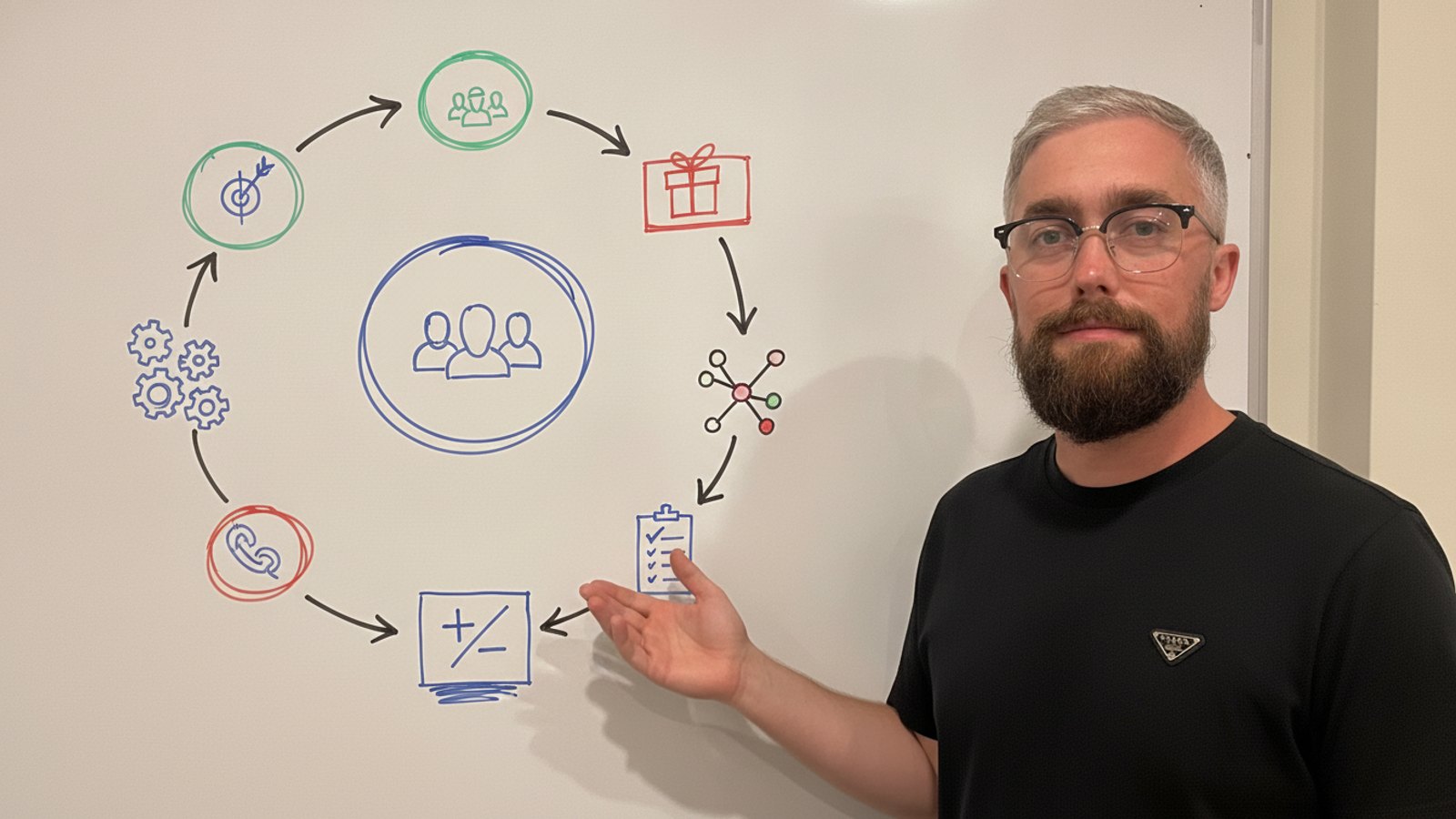

Mitch Wilder
Builder & Essayist
Most small business owners do not need more random marketing ideas. They need a plan.
Not a 40-page document full of jargon. Not a folder of half-finished tactics. A real small business marketing plan should help you decide who you are trying to reach, what you are offering, where you will market it, and how you will know if it is working.
If your marketing feels scattered, expensive, or impossible to measure, I think the fix is simpler than most people make it. You need a decision-making system. Plain and simple.
Quick answer
To create a marketing plan for a small business, set one clear revenue goal, define your ideal customer, clarify your message and offer, choose 2-3 marketing channels, build a simple lead-to-sale funnel, set a budget tied to customer value, and track results every month. The seven steps below walk through each part.
Planning is not busywork. Marketers who document their strategy are 414% more likely to report success (CoSchedule), yet roughly half of small businesses fail within five years (U.S. Bureau of Labor Statistics). A clear plan is one of the cheapest ways to improve those odds.
Key Takeaways
- A small business marketing plan is a roadmap for how you will attract, convert, and retain customers.
- The best plans start with a business goal, not a list of tactics.
- Focus on one audience, one core offer, and 2-3 marketing channels first.
- A strong plan connects marketing to sales, not just awareness to activity.
- You should work backward from revenue to determine how many leads and customers you need.
- Marketing budgets should be tied to customer value and ROI, not guesswork.
- A simple 90-day plan beats a complicated annual strategy that never gets implemented.
- If you are not tracking leads, conversion rates, customer acquisition cost, and revenue by channel, you are guessing.
What Is a Small Business Marketing Plan?
A small business marketing plan is a practical roadmap that defines your target audience, offer, message, marketing channels, budget, sales process, and success metrics.
In other words, it is how you turn growth goals into repeatable action. A marketing strategy is the thinking. A marketing plan is the execution. A campaign is one specific push inside that plan.
A good plan should answer these questions:
- Who are we trying to reach?
- What problem do they have?
- What outcome do they want?
- Why should they choose us?
- Where will we reach them?
- What will we offer them?
- What happens after they show interest?
- How will we measure results?
Why Most Small Business Marketing Fails
Most small business marketing does not fail because the owner is lazy or because the business lacks ideas. It fails because the business is doing accidental marketing.
Accidental marketing is expensive
Accidental marketing looks like this:
- Posting on social media when you remember
- Running ads without a clear funnel
- Sending emails only when sales are slow
- Publishing content with no conversion path
- Copying competitors without understanding their economics
- Trying five channels at once instead of mastering one or two
One of the things that I noticed is that businesses usually do not have a marketing problem first. They have a focus problem.
Too many ideas create weak execution
A good marketing plan does not give you more to do. It tells you what not to do.
That matters because small teams do not have unlimited time, money, or attention. If you spread yourself across SEO, paid ads, TikTok, LinkedIn, email, events, direct mail, and partnerships all at once, you usually end up mediocre everywhere.
No clear ROI means no confidence
If you do not know what a lead costs, what a customer is worth, or which channel drives revenue, you cannot scale with confidence.
My point is this: marketing feels stressful when it is disconnected from numbers.
How to Create a Marketing Plan for a Small Business in 7 Steps
The way that I look at it, every effective small business marketing plan can be built around seven parts:
- Goal
- Market
- Message
- Offer
- Channels
- System
- Scorecard
Let's walk through each one.
For a deeper breakdown of every building block your plan should include, see the essential elements of a small business marketing plan.
Step 1: Set One Clear Business Goal
Start with the business outcome. Not the tactic.
Bad goal: “We want more visibility.”
Better goal: “We want 20 new customers per month at an average value of $500.”
Work backward from revenue
Use this simple formula:
- Revenue goal ÷ average customer value = customers needed
- Customers needed ÷ close rate = leads needed
- Leads needed ÷ conversion rate = traffic needed
Example:
- Monthly revenue goal: $20,000
- Average customer value: $2,000
- Customers needed: 10
- Close rate: 25%
- Leads needed: 40
Now you have something concrete. Right?
Quick worksheet
- Monthly revenue goal:
- Average customer value:
- Close rate:
- Leads needed:
- Main constraint:
- Timeline:
Step 2: Identify Your Target Customer
The best marketing strategy for small business starts with the customer, not the business.
If your targeting is vague, your messaging will be vague. If your messaging is vague, your results will be weak.
Define your ideal customer profile
Get specific on:
- Who they are
- What they want
- What problem they are trying to solve
- What they have already tried
- What triggers them to buy
- What objections they have
- Where they spend attention
- What outcome they actually care about
Bad target audience: “small business owners.”
Better target audience: “local home service business owners doing $500K-$2M per year who rely too heavily on referrals and want more predictable booked appointments.”
That is a real audience. You can build a message around that.
Step 3: Clarify Your Positioning and Message
Your message should make the right person think, this is for me.
That only happens when your positioning is clear.
Build a simple value proposition
Use this formula:
We help [specific audience] achieve [specific outcome] without [specific pain or obstacle].
Examples:
- We help busy homeowners remodel their kitchens without delays, surprise costs, or contractor confusion.
- We help B2B service firms generate qualified leads without relying on cold referrals.
- We help ecommerce brands increase repeat purchases without constantly discounting.
Keep your messaging clear
Clever usually loses to clear.
Your message should explain:
- Who you help
- What result you create
- Why your approach is different
- Why someone should trust you
- What they should do next
If your homepage, ads, emails, and sales conversations all say different things, your marketing plan is broken at the message layer.
Step 4: Choose the Right Marketing Channels
Do not choose channels because they are trendy. Choose them because they fit your customer, offer, budget, and timeline.
For most businesses, I think 2-3 primary channels is enough to start.
Best marketing channels for small business
| Channel | Best For | Speed | Cost | When to Use It | When to Avoid It |
|---|---|---|---|---|---|
| SEO | Search demand, local services, B2B, ecommerce | Slow-medium | Medium | When buyers search for solutions | If you need leads immediately |
| Content Marketing | Trust, authority, education | Slow-medium | Medium | For longer buying cycles | If you cannot stay consistent |
| Email Marketing | Lead nurture, repeat sales, retention | Medium | Low-medium | When you need follow-up and retention | If you have no list or no offer |
| Paid Ads | Fast testing, scale, retargeting | Fast | Medium-high | When your offer already converts | If your funnel is weak |
| Social Media | Visibility, relationships, founder brands | Medium | Low-medium | When audience attention is there | If you will post sporadically |
| Referrals | Service businesses, local businesses, B2B | Medium | Low | In trust-based markets | If you never ask or follow up |
| Direct Outreach | B2B, high-ticket services, early-stage | Fast | Low-medium | When you need conversations quickly | If your targeting is unclear |
Simple selection rule
- Choose SEO if people are already searching for what you sell.
- Choose email if follow-up and retention matter.
- Choose paid ads if your offer is proven and you need speed.
- Choose referrals or outreach if you sell high-trust services.
Step 5: Build a Customer Acquisition System
Marketing is not just traffic. It is the system that turns attention into customers.
A good customer acquisition strategy maps the full journey.
Map the customer journey
Your funnel should move people through these stages:
- Awareness
- Interest
- Trust
- Lead capture
- Sales conversation or purchase
- Onboarding
- Retention
- Referral
Example funnel
- SEO article
- Lead magnet
- Email sequence
- Consultation call
- Proposal
- Sale
- Onboarding
- Referral request
Every asset in your marketing should have a next step:
- Download the checklist
- Book a consultation
- Request a quote
- Join the newsletter
- Start a free trial
If there is no next step, there is no system.
Step 6: Set Your Marketing Budget
A marketing budget for small business should be based on goals and unit economics, not vibes.
As a starting benchmark, the U.S. Small Business Administration suggests businesses under $5M in revenue spend about 7-8% of revenue on marketing — though your margins and growth stage should adjust that number up or down.
Use customer value to guide budget
Formula:
Maximum cost per customer = customer lifetime value × target acquisition cost percentage
Example:
- Customer lifetime value: $2,000
- Target acquisition cost percentage: 20%
- Maximum cost per customer: $400
Now you have a decision rule. You know how much room you have to test.
Separate testing from scaling
Testing budget is for learning:
- Which audience responds
- Which message works
- Which offer converts
- Which channels generate qualified leads
Scaling budget is for increasing what already works.
That is an important distinction. A lot of wasted spend happens when businesses scale before they validate.
Step 7: Create a 90-Day Action Plan
A marketing plan only matters if it gets implemented.
I like 90-day planning because it is long enough to build momentum but short enough to stay real.
Month 1: Foundation
- Define goals
- Identify target audience
- Clarify offer
- Write positioning statement
- Audit current marketing
- Set up tracking
- Choose primary channels
- Build a simple content calendar
Month 2: Campaign buildout
- Create your main landing page
- Build a lead magnet or core CTA
- Set up email follow-up
- Publish first content assets
- Launch referral or outreach campaign
- Test paid ads if appropriate
Month 3: Optimization
- Review traffic
- Review leads
- Review conversion rates
- Review sales results
- Identify top-performing channels
- Cut low-performing activity
- Improve messaging
- Double down on what works
How to Measure Marketing ROI
You cannot improve what you do not measure.
If you want control, track the numbers that connect marketing to revenue.
Core marketing KPIs to track
- Website traffic
- Conversion rate
- Leads
- Qualified leads
- Cost per lead
- Booked calls
- Sales conversion rate
- Cost per customer
- Customer lifetime value
- Revenue by channel
- Retention rate
- Repeat purchase rate
- Referral rate
Marketing ROI formula
Marketing ROI = (revenue attributed to marketing − marketing cost) ÷ marketing cost
Example:
- Marketing cost: $2,000
- Revenue attributed to marketing: $10,000
- ROI: ($10,000 − $2,000) ÷ $2,000 = 4
That means 400% ROI.
For the full process — what counts as marketing cost, why gross profit beats revenue, ROI vs ROAS, and a step-by-step way to do it — see this deeper guide on how to measure marketing ROI.
Do not only measure lead volume
Cheap leads are not always good leads.
Better metrics include:
- Cost per qualified lead
- Cost per sales opportunity
- Cost per acquired customer
- Revenue per channel
- Profit per campaign
Small Business Marketing Plan Example
Here is a simple example.
Local accounting firm
- Goal: Add 10 new monthly bookkeeping clients in 90 days
- Target customer: Small business owners doing $250K-$2M annually who are behind on bookkeeping and worried about tax surprises
- Positioning: We help small business owners get clean books, reduce tax-season stress, and make better financial decisions without spending hours in spreadsheets
- Primary channels: Local SEO, referral partnerships, email newsletter, LinkedIn content
- Lead magnet: Small Business Tax Readiness Checklist
- Funnel: Google search → blog article → checklist download → email sequence → free bookkeeping review → proposal
- Budget: $1,500 SEO/content, $150 email tools, $500 referral efforts, $300 retargeting
- KPIs: 500 new visitors, 50 downloads, 20 booked reviews, 10 new clients per month
That is not fancy. But it is usable. And usable wins.
Small Business Marketing Plan Template
Use this as a one-page planning document.
1. Business Goal
- Revenue goal:
- Customer goal:
- Timeline:
- Main constraint:
2. Target Customer
- Who they are:
- What they want:
- What problem they have:
- What they have tried:
- What triggers them to buy:
- Biggest objection:
3. Positioning
- We help:
- Achieve:
- Without:
- Unlike:
- Proof:
4. Offer
- Core offer:
- Price:
- Main promise:
- Guarantee or risk reversal:
- CTA:
5. Channels
- Primary channel:
- Secondary channel:
- Support channel:
- Channels to ignore for now:
6. Funnel
- Traffic source:
- Lead capture:
- Follow-up:
- Sales process:
- Retention:
- Referral:
7. Budget
- Monthly budget:
- Testing budget:
- Tools:
- Paid media:
- Content:
- People:
8. Scorecard
- Leads:
- Qualified leads:
- Customers:
- Revenue:
- Cost per lead:
- Cost per customer:
- ROI:
- Next action:
Common Small Business Marketing Plan Mistakes
Starting with tactics instead of strategy
“Should we be on TikTok?” is usually the wrong first question.
The better question is: where does our ideal customer already look for help?
This is often a leadership problem more than a marketing problem. If your executives disagree on goals, marketing inherits the confusion — so it helps to align leadership with marketing goals before you argue about a single channel.
Trying too many channels
Focus compounds. Sprawl kills momentum.
Ignoring follow-up
A lot of businesses spend money generating leads and then fail to follow up fast enough or consistently enough to convert them.
Not tracking ROI
If you cannot measure what is working, you cannot confidently improve it.
Copying competitors blindly
Your competitors may have different margins, offers, budgets, and goals. Their strategy may be wrong for your business.
FAQ
What is a marketing plan for a small business?
A marketing plan for a small business is a practical roadmap for how the business will attract, convert, and retain customers. It usually includes the target audience, offer, messaging, channels, budget, timeline, and KPIs.
How do I create a marketing plan for my small business?
To create a marketing plan for your small business, start with a clear revenue goal, define your ideal customer, clarify your message and offer, choose 2-3 channels, build a simple funnel, set a budget, and track results monthly.
What should a small business marketing plan include?
A small business marketing plan should include business goals, target audience, positioning, offer, marketing channels, content strategy, budget, sales funnel, retention strategy, KPIs, and a 90-day implementation plan.
What are the best marketing strategies for small businesses?
The best marketing strategies for small businesses usually include SEO, content marketing, email marketing, referral marketing, partnerships, direct outreach, social media, and paid advertising. The right mix depends on your customer, business model, budget, and timeline.
How much should a small business spend on marketing?
A small business should set its marketing budget based on growth goals, margins, customer lifetime value, and acquisition targets. Early-stage businesses often start with lower-cost channels and increase spend once they find what works.
How often should you update your marketing plan?
Review activity weekly, evaluate performance monthly, and update the broader plan quarterly. That keeps the strategy current without constantly changing direction.
Final Checklist
To create a marketing plan for a small business:
- Set one clear revenue or customer acquisition goal
- Define your ideal customer
- Identify their biggest pain and desired outcome
- Clarify your positioning and value proposition
- Choose 2-3 focused marketing channels
- Build a simple customer acquisition funnel
- Create a follow-up process
- Set a realistic marketing budget
- Track the right marketing KPIs
- Review weekly and improve monthly
Conclusion
Your small business does not need a more complicated marketing plan. It needs a clearer one.
Start with the customer. Set a real goal. Choose fewer channels. Build a simple system. Track the numbers. Improve what works and cut what does not.
That is how to create a marketing plan for a small business that actually works. Not by doing more marketing, but by doing more intentional marketing.
If you want the fastest next step, build this into a one-page document today and turn it into a 90-day operating plan. That alone will put you ahead of most businesses that are still doing accidental marketing.
Related Reading
- The essential elements of a small business marketing plan — a deeper breakdown of every component your plan should include.
- Marketing strategies for startups — how these same fundamentals apply when you are early-stage and moving fast.
- 12 effective direct marketing techniques — the campaigns and channels you use to execute the plan and drive a measurable response.
- 10 marketing plan mistakes that waste time and money — the planning and execution errors to avoid as you build this plan.
- How to measure marketing ROI — the formula, metrics, and step-by-step process for tracking what your marketing actually returns.
- How to align leadership with marketing goals — get your leadership team agreed on goals, owners, and KPIs before you spend a dollar.